Saturday, 5 July 2014

Joseph Beresford Shields 1879-1918

I don't know how these papers came to survive in a Deed Box from Meek, Stubbs & Barnley, solicitors, Middlesbrough.

A small envelope contains a letter from Joe Shields to his mother, his birth certificate and a letter from his mother to Mrs (or Miss) Wilson, his friend.  Joe's letter is dated 17 August 1916 and is sent from B Company, 9th Bedfordshire Regiment, stationed at Sittingbourne, and it's about the food he is looking forward to enjoying on a short leave:


His mother was Emily Julia Shields, née Mullen, and Joe was born in Stockton:


In July 1918 Mrs Shields wrote to a Mrs (or Miss, the title is altered in pencil) Wilson at Leigh-on-Sea, Essex.  The letter was forwarded to the Victoria Naval Hospital, Southend:

Joe has been reported missing, although his mother is still hoping for good news.  Her letter shows no address but one has been written in pencil on the reverse:


Sadly, there was to be no good news.  Joseph was killed in action on 24 May 1918; his grave is at Pozieres Memorial Cemetery.

It seems likely that the Mrs or Miss Wilson to whom Mrs Shields wrote this touching letter is the Miss Elizabeth Ann Wilson named as an executor of his Will.  She kept the boarding house in which he lived in Leigh-on-Sea.

His last address as a civilian (and the address given in the National Probate Calendar) was 19 Southend Southsea Avenue, Leigh-on-Sea.  He was living there at the time of the 1911 Census, which shows that the boardinghouse keeper was Mrs Elizabeth Ann Wilson, aged 46 and born in Boosbeck, Cleveland, and that Joseph was then 31 years old, unmarried and a draughtsman at the Marine Engine Works.

So it seems probable that Mrs Shields is addressing this Elizabeth Ann Wilson when she writes

I always felt my Dear Son had a good friend in you which I can assure you has taken a load off my mind.  I shall always count you as one of my dearest friends always write to me dear it will be such a consolation to me 

If there are any members of Joe's family out there who would like this letter, do please contact me ...

Tuesday, 1 July 2014

Letters Patent of James VI & I


This is a Licence to Alienate.  These Letters Patent of King James VI & I gave Ralph Stowpe permission in 1616 to sell to Robert Layton a cottage, toft & croft, 2 oxgangs & 19 ½ acres of land in the area of Marske, Upleatham and Redcar.


The Great Seal is a little battered. This is the reverse of the deed and the seal:


At some point this deed came into the hands of Middlesbrough solicitor Thomas Duncan Henlock Stubbs.  He took it to the noted scholar and antiquarian Thomas McAll Fallow at Coatham House.

Mr Fallow was born in 1847 and educated at Brighton College and St John's, Cambridge.  He originally intended to take Holy Orders but instead divided his time between parish work and scholarship.  He acted as layhelper to his cousin the Rev R B Kirby at Chapel Allerton, Leeds between 1872 and 1885, and then moved to Coatham where again he was active in the parish but primarily devoted his time to archaeology.  He was editor of The Reliquary and The Antiquary, and died in 1910.  Here is his letter to Stubbs:


And this is his transcription of the Letters Patent:


Tuesday, 24 June 2014

Thomas Graham of Ayton Hall & his family

More notes on Thomas Graham. 

For this information I am very grateful to Trevor Littleton of the Cumbria FHS:-

The parents of Monkhouse & Thomas Graham were Thomas Graham and Ann Bell.  She was the sister of William Bell of Tarraby Farm.

Margaret Graham, sister of Monkhouse & Thomas, married James Maguire, a cattle dealer from Co Antrim.  In 1841 their daughter Mary Ann married James Forster, who farmed at Tarraby.

When Mary Ann Forster's mother Margaret Maguire died aged 70 in 1850 ("deeply regretted, and most deservedly respected. She was an affectionate parent and a sincere friend to the poor" according to the notice in the Carlisle Journal) she was living at The Beeches, Tarraby.  When Mary Ann Forster writes to her uncle Thomas Graham of repairs to the house, it appears that she is referring to work being done to The Beeches.  The builders were apparently still at work when the house was put up for let:
Carlisle Journal, Friday 8th November 1850

To be LET, and Entered upon immediately , an excellent DWELLING HOUSE &c, situate at TARRABY, the residence of the late Mrs. MAGUIRE; consisting of Parlour, Kitchens, Pantry, and other conveniences with Four good Lodging Rooms, Orchard, and Kitchen Garden – For particulars, apply to Mr. JAS. FOSTER, Tarraby; or Mr. CHAS. ARMSTRONG, Builder, Carlisle.
Rent Moderate.
Tarraby, Nov. 7th 1850.
Mary Ann died only a few years after she wrote to her uncle:
Carlisle Journal, Friday 17th February 1854 
At Tarraby, on the 7th inst., Mary Ann wife of Mr James Foster, aged 43, and the last of the family of the late Mr. James Maguire.
I don't know whether Thomas Graham is remembered in any monument or tomb at Great Ayton, but he is certainly commemorated in his native Cumbria.  There is a monumental inscription to Thomas Graham of Ayton Hall inside Stanwix church.


2 March 2021:  I've just realised that I should have added this information quite some time ago

For more on the Graham family of Knockupworth, see Knockupworth: The story of a family by John Bainbridge (details here)

And for a flavour of this this fascinating story, see this piece in the News and Star

Monday, 23 June 2014

Thomas Graham of Ayton Hall

Ayton Hall stands near the River Leven in the large picturesque village of Great Ayton.  At the end of the 18th century it was the home of the Wilson family; Captain James Cook and his wife stayed there as the guests of Commodore William Wilson in 1771.

Some decades later, the occupants were Thomas Graham and his family.  He was living in Great Ayton by 1811 and was at the Hall for the censuses of 1840, 1850 and 1860.

Thomas was born in Cumberland in about 1777.  He was the son of Thomas and Ann Graham of Knockupworth House near Carlisle (which I assume is the building now called Knockupworth Hall)

In 1805, Thomas's elder brother Monkhouse Graham died, some weeks after making his Will.  He was probably in his late thirties and left neither wife nor child.  His beneficiaries were his mother Ann and his siblings Thomas, Letitia, Mary and Margaret.  They shared the money he had made as a merchant in Liverpool and the property he had bought in Tarraby in the parish of Stanwix, just north of Carlisle.

First page of copy Will of Monkhouse Graham
Last page of copy Will of Monkhouse Graham

Thursday, 19 June 2014

Thursday, 12 June 2014

Nunthorpe Mothers' Union 1957

I hadn't realised we had this photograph - it goes rather nicely with previous posts about Nunthorpe Women's Institute, I think.


Nunthorpe Mothers' Union 1957

Tuesday, 3 June 2014

Francis Stainthorp, weaver of Hutton Rudby

Do have a look at this post on Paul Stainthorp's blog about his ancestor Francis Stainthorp (1765-1822) - I have to say I was particularly taken with the photo of Francis's great-great-great-great-great-great grandchildren at his tombstone!

Sunday, 1 June 2014

Women's Institute Drama Festival held at the Middlesbrough Little Theatre, 5 May 1956


Bolton-on-Swale
In Merry Wives of Windsor
F Crankshaw
J Gibson
R Heylings
R Hills
E Shield
K Barber
H Gibson
J Nelson
K Chapman
N Mason
J Hills
W K Gibson

Melsonby
In Mary Frobisher by F Sladen-Smith
K Dunn
N Hawitt
M Gregory
I Elliott
G Milner
G Simpson
M Dodsworth
J Morton

Guisborough
In Closed Windows by Nora Ratcliff
E Taylor
E Payne
M Pilkington
C Oliver
A Armin
K Jackson

Well & Snape
In Two of Us by Elma Verity and Jack Last
F Bell
G Sampson
F Nelson
M Craddock
J Dawson
D H Owen

Hutton Rudby
In Mad Hatters in Mayfair by Barbara Van Campen
I Shore
C Honeyman
A Atkinson
J Hardcastle
H Carpenter
R Swales
P Deacon
M C Reauley

Nunthorpe
In Staff Room by Albert Claydon
B Colwell
R Masters
J C Marr
M Stubbs
M Ballingall
P Bilton
K Marr
E Winney

North Cowton
In Women within Walls by A J Bradbury
G Stevenson
C Bainbridge
J Murray
M Marley
D Allison
A M Boddye

Hutton Bonville
In One Crowded Hour by Conrad Carter
K Donald
M Duffield
R Donald
M Andrews
M Bosomworth
D Bell
M Foster
D Porritt

Wednesday, 28 May 2014

Nunthorpe W.I. Drama Society, 30 May 1952


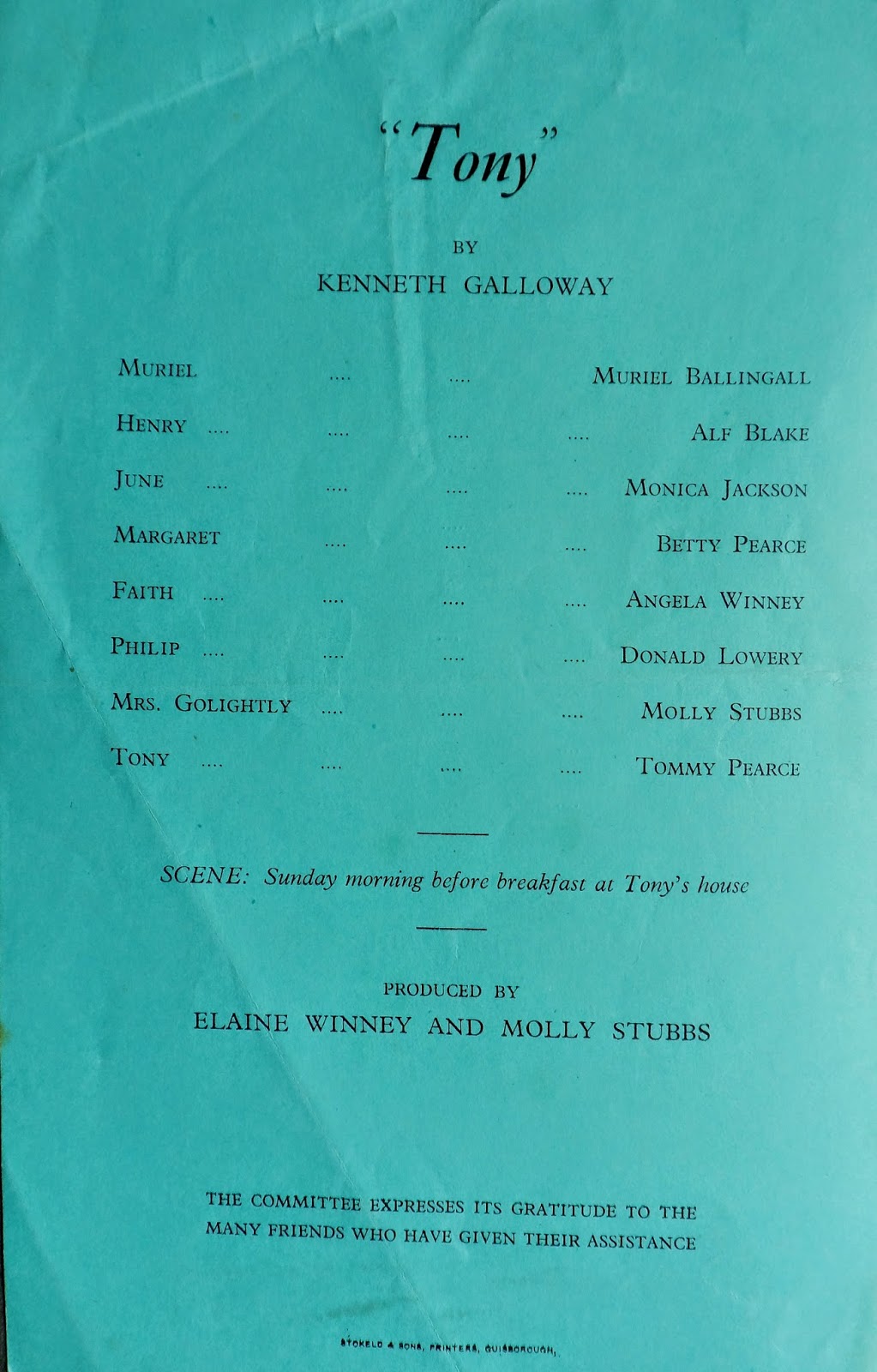
Appearing in Time out of Joint by Gerard McLarnon, The Bakehouse by J O Francis, and Tony by Kenneth Galloway:

Aline Baker
Muriel Ballingall
Kathleen Belas
Alf Blake
Beryl Colwell
Freda Cooke
Mahoney Crosthwaite
Gillian Doel
Jeff Flower
Helen Hastings
Monica Jackson
Donald Lowery
Olga Matthams
Betty Pearce
Tommy Pearce
Lesley Pearson
Molly Stubbs
Angela Winney
Elaine Winney
Sandra Winney


Sunday, 25 May 2014

More W.I. drama from Nunthorpe and Great Smeaton


I think this must date from the 1930s as some of the names are the same as those listed in the WI concert of 1936.

Saturday, 24 May 2014

Women's Institute drama at the Nunthorpe Institute, December 1936


Appearing in Wrong Numbers by Essex Dane, Mrs Biddlecombe and the Furriners by Geoffrey Whitworth and Symphony in Illusion by James Wallace Bell were:

Mrs H Chester
Mrs J J Hyde
Mrs H Ward
Miss Prince
Mrs G P Cook
Mrs J Ballingall
Mrs H Stubbs
Mrs MacGillivray
Mrs A Whinney
Mrs J Borrow
Mr H Chester
Mrs H Belk
Mrs Hedley

The married women are probably listed under their husbands' names; 'Mrs H Stubbs' certainly indicates Mary Stubbs, wife of Hugh.


Monday, 19 May 2014

The Nunthorpe Institute

An interesting item for those who remember the original Nunthorpe Institute, which was erected in 1920 in Connaught Road.  It had previously been an Army Hut in Stewart Park. 

The costs were met by setting up a limited company and issuing shares:

Share certificate for the Nunthorpe Institute


Thursday, 15 May 2014

John Vaughan, ironmaster

Middlesbrough commemorated the great ironmaster John Vaughan some fifteen years after his death by erecting a statue:


Medal to commemorate unveiling of statue of John Vaughan

At the base of the statue are the words:

John Vaughan
1799-1868
Mayor of Middlesbrough 1855
Discovered ironstone in the
Cleveland Hills, founder of the iron
trade in Cleveland, partner in
Bolckow, Vaughan & Co. Ltd., who built
one of the first iron works in
Middlesbrough in 1840


Reverse of the medal

For more details on the statue, including photographs of the panels depicting mining and industry, visit the Hidden Teesside website.

There is a portrait of John Vaughan in Middlesbrough Town Hall - but you can look at it on the BBC's Your Paintings website.


Saturday, 10 May 2014

Update to Christmas Greeting 1914

I've just added a transcription of the names of the men listed in the Roll of Honour in the Christmas Card from the Heaton Road Baptist Church - to make the post easier to find for anybody who might be out there searching for information on a particular name.


Friday, 2 May 2014

The Middlesbrough Opera House for sale, 1907

I found this amongst my old papers:


It has two rather nice sketches "for purposes of illustration only, and their accuracy in points of detail is not guaranteed":


The Particulars show that:
The Theatre, designed from Plans prepared by Messrs Hope & Maxwell, Newcastle-on-Tyne, the well-known Theatrical Architects, was erected in 1903, and is a Building with a commanding appearance.  It is well built, and has a frontage to Linthorpe Road of 100 feet and to Southfield Road of 152 feet 6 inches, and an area of 1,750 square yards or thereabouts.  The premises are built with Accrington bricks and artificial stone dressing, and are in a thorough state of repair.

The position is a most central one, on a splendid site in two of the principal thoroughfares of Middlesbrough, and a population of about 250,000 is resident within a radius of 4 miles, with an excellent tram and train service to all parts.
It had a holding capacity of 3,300 persons, with 10 Private Boxes, Orchestra Stalls, Dress Circle, Upper Circle, Pit Stalls, Pit, Amphitheatre, Gallery and Standing Room.  There were two Foyers "of ample dimensions" with "hand-painted and elaborately decorated ceilings and mosaic pavements".  There were six Cloak Rooms and four Saloon Bars.  It was lit throughout by Electricity, and had Gas laid on in case of emergency. 
There is a Glass Verandah covering the Entrances and Exits and Shops on the Linthorpe Road side, which is continued to the Grand Entrance in Southfield Road, forming an excellent protection in wet weather to those waiting admittance.

The Chocolate Machines annexed to the seats, and their contents, are not the property of the Vendor, and are not included in the Sale; these Machines are the property of the Theatres' Sweetmeat Automatic Co., Ltd ...

Sadly, this grand building was being sold by the Receiver appointed by the Debenture Holders of the Middlesbrough Grand Opera House Company Ltd.


Wednesday, 30 April 2014

Concert troupe in the First World War

These photographs are from a concert troupe called The Headlights.

"The Headlights on Demobilization"
On the left (seated) is Private Henry (Harry) Storey.  At the outbreak of war he was living with his family in the road where he was born, Felton Street in Byker.  He must have been seventeen or barely eighteen when he joined the Royal Army Medical Corps (Territorials) in Newcastle.  According to family tradition he was a bugler – each Field Ambulance had a bugler. By the end of the War he was in the Army Service Corps.

Henriette Vienne & Harry Storey
This photograph is signed "Meilleur souvenir, H. Vienne" and "Sincerely yours, Harry Storey".

"Avec mon meilleur souvenir de la troupe Headlights, Henriette Vienne"

The Band

This must be the band that played for the Headlights troupe.  On the reverse is written "Sincerely yours" followed by two signatures:
Ted C. Chopping
George Howarth

Harry Storey's family had a great love of theatre. His father, John Henry Brett Storey, worked on the railways but his heart was given to drama and music and in his evenings he worked backstage.  Harry himself, after several years of great enjoyment as an amateur actor during the War, was very close to taking to the stage as a professional after 1919 – his sister Nancy was to be a Gaiety Girl.  Marriage in 1921 and a growing family must have played a part in his decision to take less risky employment. He set up his own successful building company in Newcastle and, after growing bored with retirement, was involved in the printing business of Hindsons, which was later bought up by Jordisons.

If anyone recognises any of the other men in the photo – or knows anything about Henriette Vienne – do please let me know!

(Harry Storey was my grandfather, btw)


Monday, 28 April 2014

Christmas Greeting 1914

A Christmas card was sent in 1914 by the Heaton Road Baptist Church in Newcastle upon Tyne to the young men of the congregation who had joined the armed forces.  This particular card was sent to 18 year old Private Harry Storey of the R.A.M.C.  He lived with his family at 40 Felton Street, Byker.


The minister wrote that
I am desired by your many friends in the Church and Sunday School to convey to you our united wishes for your welfare, our earnest prayer for your safety in the hour of peril, and our strong hope that amidst the temptations and difficulties that beset your path, you will remain true to the ideals taught you by loving hearts, in the days that are past.


The recipients are listed in the Roll of Honour:


 but one of them already would not be coming home.  William Stanley Green had died in the sinking of HMS Aboukir.


The names listed in the Roll of Honour are:
Pte. H. Armstrong, Com. Battalion
*Pte. Norman Ayre, R.M.
*Pte. William Aitkin, R.M.
Pte. C. E. Bennison, R.A.M.C.
*Pte. T. Burdon, R.N. Brigade
Gunner J. Calff, R.E.
2nd-Cpl. H. Campbell, R.E.
Sapper J. Campbell, R.E.
Pte. W. Catto, London Scottish
A. Youll Catto, R.N., H.M.S. Assistance
Pte. F. Crosier, Com. Battalion
Pte. O. Y. Charlton, R.A.M.C.
Pte. Harry Dodds, R.A.M.C.
Pte. G. Daley, Com. Battalion
Pte. R. Dixon, Com. Battalion
Pte. T. Galdrath, Com. Battalion
Pte. J. Glass, 6th N.F.
Lc-Cpl. J. Gow, 11th N.F.
Sidney Green, H.M.S. Lancaster
Stanley Green, H.M.S. Aboukir
Driver S. Harris, R.F.A.
Pte. A. Hargreaves, Com. Battalion
Pte. J. Hall, Com. Battalion
Pte. E. Hutson, Com. Battalion
*Pte. W. G. Innis, R.M.
*Pte. G. W. Jobes, R.N. Reserve
Cpl. J. Murray, R.E.
Drill Instructor Linton, Gordon Highlanders (Canada)
Pte. J. A. Mitchell, 5th N.F.
Pte. J. Morrison, Com. Battalion
Pte. T. Morrison, Com. Battalion
Pte. J. McCutcheon, R. Marines
*Pte. J. McFarland, R. Marines
Pte. J. Lambert, R.E.
Pte. J. Locke, Com. Battalion
*Pte. A. Nutt, 6th N.F.
Sgt. J. Proudman, R.F.A.
Bugler R. Pritchard, R.F.A.
Pte. T. Ridley, A.S.C.
Lc.-Cpl. F. Reeves, 6th N.F.
Pte. J. Swift, Com. Battalion
*Pte. Harry Storey, R.A.M.C.
*Fred Taylor, H.M.S. Black Watch
Petty Officer T. G. Thompson, H.M.S. Mohawk
Cpl. Miles Veary, R.E.
Pte. Tom Wilkinson, Nth. Cycl.
*Pte. E. Wraith, R.A.M.C.
Pte. R. Walker, R.E.
Pte. A. S. Watson, A.S.C.
Pte. W. Whitmore, 6th N.F.
Pte. E. Yeoman, Com. Battalion
Pte. S. Yeoman, Nth. Cyclists

* Byker Baptist Mission

Friday, 4 April 2014

A further detail to the story of Kitty Martineau

I have just found a note – as I continue to go through the last of my papers – to add to the story of Katherine Dawson Martineau, as told in the story of Helen Savile Clarke and her daughters.  (The series of posts on Henry Savile Clarke, his wife Helen Weatherill and their daughters begin here)

Kitty, a beauty with "violet eyes," died a few days after the birth of her son Esmond, on 7 December 1901.  She was looking quite well and was receiving visitors, when she called, "Nurse! nurse!" and died.
The story comes from her second cousin Madge Buchannan and may be true.

Her death certificate gives the cause of death as:
Alcoholism, eight months
Child Birth, four days
Acute Uraemia, four days
certified by Robert Boxall, M.D., of 40 Portland Place, Marylebone, present at the death
I didn't include this detail in the original piece, partly as I felt unqualified to comment on it, and partly because I couldn't quite bring myself to do so at the time.

On looking into it further, I think all I can comment is:

As far as I understand, "uraemia" is a term which was first used in 1840 to describe a patient in renal failure.  In this case it may be more an observation of symptoms than a diagnosis.  I notice that the Revised US Standard Certificate of Death instructions to be found in Mortality Statistics, vol 9 by the US Board of Census (1909), states
“Never report mere symptoms or terminal conditions such as […] “Uraemia” […] when a definite disease can be ascertained as the cause.  Always qualify all diseases resulting from childbirth or miscarriage."
I think all that can be ascertained (in the absence of someone experienced in historical medical terminology) is that she died four days after child birth and that her kidneys had probably failed.  

And to think of that beautiful woman, who had lost her parents and her sisters so suddenly and in such a short space of time, suffering from alcoholism through her pregnancy – that's just too sad to comment on.


Sunday, 30 March 2014

The family of the Revd Henry Clarke of Guisborough (1813-61)

I have just come across these notes made by the late Miss Grace Dixon, noted Guisborough historian.  They end with a lovely reminiscence of Guisborough in the early twentieth century:

Henry Clarke, master mariner of Whitby, died 1780.  Wife was Joan.

Henry Clarke, only son (presumably to have survived infancy?) married Elizabeth, who was buried in Guisborough 30/7/1827 aged 79, described as "widow of H. Clarke, late of Whitby"

Henry Clarke, solicitor, (1785-1862) married Elizabeth Hutchinson of Guisborough in 1811.  He had a brother John and 3 sisters.  He was in Guisborough in the early C19.
Elizabeth was born Guisborough and died 1862, aged 75, one week after her husband's death.
Both were buried in Guisborough.

Reverend Henry Clarke (1813-1861) not born Guisborough, married (1840) Catherine Francis Dawson, b Ripon.  She died 1852 aged 33.  First wife.

Children:
Henry Savile, b1841 married Helen Weatherill; 3 daughters [he was baptised Henry Clarke - the name Savile appears later]
John William "Jock" (1842-1921) married Marjorie Gow of Cambs in 1877; no children
Rev Arthur Dawson b1843, living 1922.  Became priest in 1883, but in holy orders only until 1889
Francis (1845-1900) Professor of Music in Guisborough [he was baptised Francis Savile Clarke]
Cecil James b1846
Catherine b1849
Reverend Henry married as his second wife Ann Louise Weatherill in 1857.  He became incumbent of St Nicholas, Guisborough, in 1836 when two of the Williamson family, father and son, curates, died of cholera.
He was the first incumbent to inhabit the new parsonage of Guisborough from 1859 but did not live to see it become a Rectory.
A plaque in Latin was erected to his memory on the south side of the chancel in the church.
Ann Louise Clarke survived her husband and remarried.

John William Clarke was the Land Agent to the Gisborough estate, and must have had many differences of opinion with Wm Richardson in the latter's work for Guisborough Council.  Mrs Channon [the late Mrs Diana Channon, daughter of William Richardson] remembers seeing Mr Clarke
"turn out of his stable yard at Kemplah House to go up to Gisborough Hall in a dogcart with a 'Tiger' with top hat and cockade on the back seat and a dalmatian dog running underneath.  All of them (except the dog) suitably clad.  A lovely sight."

23 February 2021:  Another detail on the Revd Henry Clarke

The Revd Henry Clarke, who had been appointed to the perpetual curacy of Guisborough in 1836, married Catherine Frances Dawson, daughter of the late William Dawson of Azerley Hall near Ripon, on 13 May 1840 at Guisborough.

A note in the Walter Brelstaff Archive shows that there is a memorial on the wall of the south aisle of Guisborough parish church to a Mrs Anne Pullan, who died on 24 January 1838 at the age of 42.  She was the widow of William Dawson of Azerley Hall when she married Edward Pullan of Skelton.  This probably explains how Catherine Dawson came to Cleveland.


Friday, 28 March 2014

Sir Thomas Layton finds himself before the Star Chamber, 1633

Sir Thomas Layton (1597?-1650) was the son of Charles Layton of Sexhow (d1617) and his wife Mary Milner of Skutterskelfe (c1568-1633).

Sir Thomas's grandfather, the lawyer Thomas Layton (1520-84), had left his family in a fine position through his years of private practice, public service and astute property dealings.  The marriage of Thomas's parents in 1594 had completed the work, reuniting the manors of Sexhow and Skutterskelfe under one ownership for the first time since the death of their ancestor John Gower in 1377. 

Sir Thomas came into his inheritance as a very young man on his father's death in 1617.  Just how young he was, is rather hard to say.  He is recorded in the 1612 Visitation [cf Graves' History of Cleveland] as being 15 years old and that would certainly accord with the transcription made of the baptismal register by J W Ord and by the Christian Inheritance Project; they disagree on the month (February or July) but they agree on the year.  The Victoria County History entry for East Layton in the parish of Stanwick St John states that he was 23 on his father's death [citing Chan. Inq. p.m. (Ser. 2), ccclxvii, 93]; his parents married on 27 February 1594, so this is possible.

His father arranged for him to be married at a very young age – probably 16 (or at the most 19), for it was in 1613 that Charles settled the manor of Kirkby Sigston upon his son.  Thomas's wife was Mary Fairfax, daughter of Sir Thomas Fairfax of Walton and Gilling Castle near Malton.  The Fairfax family had been suspected of Catholic sympathies over the years, but most of them had remained loyal to the Crown in the Northern Rebellion of 1569.  Sir Thomas Fairfax himself was a committed Protestant and so much trusted by government that he continued to hold office in spite of his wife's open Catholicism.  Catherine, daughter of Sir Henry Constable of Burton Constable, was a known recusant and her mother was accused of harbouring priests associated with the exiled Earl of Westmorland.  Catherine (who died in 1626) had sent two of her seven sons to Catholic seminaries on the Continent;  her daughter Mary's religious affiliations are unknown.

A knighthood was bought for Thomas from King James VI and I – knighthoods were in cheap and plentiful supply during the reigns of James and his son Charles I, who together created 3,281 knighthoods between 1603 and 1641.  It was a far cry from the knighthood bestowed on his great-grandfather Sir James Metcalfe of Nappa in Wensleydale.  Sir James had served on the Border under the future Richard III and held many high offices for the Crown – and probably fought at Flodden – before Henry VIII knighted him at Windsor at the age of 68.  Young Thomas was knighted in 1614, the year after his marriage [Victoria County History: Stanwick St John, citing Chan. Inq. p.m. (Ser. 2), ccclxvii, 93].

The young couple must have begun a family immediately, because Sir Thomas was a grandfather before he was forty.  He had married his daughter Mary to Henry Foulis, son of Sir David Foulis, 1st Baronet of Ingleby, and their son David was baptised on 14 March 1633.

This connection with the Foulis family was to bring him to trial before the Star Chamber in 1633.

Friday, 21 March 2014

The interior of All Saints', Hutton Rudby

A few photographs of All Saints' from the collection of the Hutton Rudby History Society:

All Saints', Hutton Rudby c1890

This postcard is said to date from c1890.  You can see here that the pulpit (gift of Thomas Milner of Skutterskelfe) is on the left of the chancel in front of his burial place and the surscription above it.


All Saints', Hutton Rudby in early C20

This view was taken at much the same time – late 1890s or early 1900s – and apparently from the top of a ladder.  The side altar had not then been restored (the Lady Chapel took its present configuration in the 1923 restoration) and the "Sexhow pews" faced sideways towards the pulpit.  The absence of stained glass is very noticeable.


This photograph (posted previously in the piece about Thomas Milner) is of much later date and shows the pulpit moved to its present position and Thomas Milner's burial place not yet obscured by the organ.  The stained glass in the East window was given by Sir Robert Ropner in memory of his wife at the 1923 restoration.

And here is the East window in glorious colour:


The artist was John Charles Bewsey, who described it as "expressing the worship of Christ, the Incarnate Word of God, by the whole company of Saints, Evangelists, Apostles, Martyrs, Prophets, Doctors of the Church, Virgins and Confessors."

The upper range of figures shows from the left: St Jerome (in red) and St Ambrose; Mary, Mother of God; Christ in majesty; John the Baptist; St Augustine of Hippo and Gregory the Great.

The lower range of figures shows from the left: King Edward the Confessor, St Francis of Assisi and St Wilfrid; St Ethelreda of Ely, St George and St Monica; Christ crucified, with His Mother, St John and Mary Magdalene at His feet; St Joan of Arc, St Gilbert of Sempringham and St Catherine (with her wheel); St Sythe, St Oswald King of Northumbria and St Cuthbert (shown kneeling with Oswald's head.)

(Details taken from a fuller account in Canon D F Lickess' 'History and Guide' to the church)

There is a beautiful collection of photographs of the stained glass in the church on flickr – in fact it's easier to see details in that collection than if you stood in front of them!


Saturday, 15 March 2014

Thomas Milner of Skutterskelfe: notes, sources & select bibliography

In order to make the preceding piece about Thomas Milner readable, I have moved a good bit of the detail into these notes.  Here you will find references, extra information and hyperlinks.


Thomas Sowthwaites alias Milner

In quoting the will I have generally modernised the spelling .  A few letters at the ends of the lines of writing are illegible because of the binding, and these I have indicated by square brackets. 
In the comment regarding his father-in-law's estate, 'unloving brethren' for 'loving brethren' is conjecture, but there are clearly a couple of illegible letters there.

The grant of wardship and marriage of Thomas Milner to Thomas Laton [sic]:
Grants in November 1534
33. Thos. Laton. Annuity of 3l. issuing from a third part of certain lands specified in Faceby, Yarum, Carlton, Semar', Broughton, and the reversion of the manor of Skutterskelf in Cleveland, Yorks., which lately belonged to Thos. Lyndley, deceased; during the minority of Thos. Milner, kinsman and heir of the said Thomas; with the wardship and marriage of the said heir. Del. Westm., 24 Nov. 26 Hen. VIII.—S.B. Pat. p. 1, m. 4.
cf: Henry VIII: November 1534, 26-30, Letters and Papers, Foreign and Domestic, Henry VIII, Volume 7: 1534 (1883), pp. 550-560 online here

The marriage of Mary Milner and Charles Layton
Details of an Indenture dated 11 July 11 James (1613) citing the Indenture of Covenants bearing date 26 Feb 37 Eliz (1594) between Charles Layton of the one part and John Constable of Dromonby, Nich. Gower of Staynesby, Esqres., Will. Baite and Tho. Baite of West Laithes, John Constable of Lasinby, Tho. Warcopp of East Tanf[eild], Leon. Baite of West Laithes, gentlemen, and John Milner of Whitwell, gent. can be found in Quarter Sessions Records (ed Rev J C Atkinson) vol 4 (North Riding Records), p141

Friday, 14 March 2014

Thomas Milner of Skutterskelfe: the life & times of a Tudor gentleman

Thomas Milner of Skutterskelfe, a gentleman of about sixty-four years of age, made his will on 28 June 1589, the year after the Spanish Armada.  He had inherited his mother's share of the estate of his grandfather, Thomas Lindley, including one-third of the manor of Skutterskelfe where he lived with his wife Frances Bate and their daughter Mary, aged twenty-one. 

He does not seem to have been suffering from ill health when he made his will – simply describing himself as "whole of mind and remembrance thanks be given to God" – and was possibly prompted to do so because of his extreme irritation at the behaviour of his wife's family over the estate of his father-in-law, who had recently died.  Thomas's will, after careful directions for his burial in All Saints' at Hutton Rudby and legacies to the church (with forthright comments about the current incumbent and his predecessors), proceeds with a bequest to his wife:
"my best breeding mare, my best nag to ride upon, with five of my best kine."
This is immediately followed by a confirmation that she is to have
"all such things as in right she ought in conscience to have and be answered of"
continuing, in a fling against his mother-in-law (for how could he leave his wife his father-in-law's goods?)
"either of mine, or of the goods of her father to whom she was executor, and got nothing thereby of things certainly known to be embezzled at the death of her father by her mother as may appear by a note [in] writing set down whereof she should have had a part, and got nothing through the greedy dealings of her [un]loving brethren, and the witness of some of no great honesty nor yet true feelings therein"
After this, he continues with the disposal of the residue of his estate to his wife and daughter, a legacy to the poor of the parish, and bequests and legacies to family, servants and godchildren.  His will, and the surscription set above his burial place in accordance with its provisions, provide us with valuable details of his family and a picture of gentry life in Cleveland in the sixteenth century.

Wednesday, 12 March 2014

Arthur John Richardson of Guisborough 1895-1915

This verse was found by the late Miss Grace Dixon among the Chaloner papers, according to a note in my files.

It relates to "Jock" Richardson of Miltoun House, Guisborough.  He was in barracks in Newcastle, training for the Front, when he died of meningitis a few weeks before his twentieth birthday.

The lines, written by his great-uncle George Buchannan of Whitby, must echo the feelings of many families whose loved ones died in uniform, but not in action:

2nd Lieut. A. J. B. (Jock) Richardson
Obt. Jan. 4th, 1915

Not on the battle field, yet none the less
He died for England: in her hour of stress
And peril, his young life he freely gave,
And rests with honour in his quiet grave.

Monday, 10 March 2014

Charles William Southeran 1875-1916

I post here a piece sent to me by John Nichols with the story of his grandfather.  The jolly photograph seems particularly poignant:

The face behind a name on the Hutton Rudby War Memorial
“Private Charles William Southeran, 5705. 6th Battalion Durham Light Infantry, formerly 28674 Yorkshire Regiment. Killed 5 November 1916.
Born Stokesley (Yorks), Enlisted Stokesley, Resided Hutton Rudby RSO
Buried WARLENCOURT BRITISH CEMETERY”
Charles William Southeran 1875-1916

Charles William (centre) was my maternal grandfather. He was born in Stokesley in 1875 so the time of Attestation on the 16th December 1915 he was 39 years and six months old.

In 1881 He was living at Enterpen but by 1891 he was at Hill House, Middleton on Leven where he was farming with his father Robert. It appears he was one of seven children, one of whom, Robert Wetherill, is shown at right. Charles’ father Robert (Snr) was married to Isabella, née Wetherill.

In 1908 Charles William married Mary (Polly) Bellerby who had moved to Hutton Rudby from Seaham Harbour sometime after 1901.

In 1911 they were living at North Side, Hutton Rudby and they went on to have three girls:
Mary (who married John Henry (Jack) Bainbridge from Hutton), Emily (who married Arthur Henry Wilson and farmed at Tanton) and my mother Dorothy born in, 1914, (who married Arthur Norman Nichols from Seamer).

Charles was Mobilised on 13th June 1916, Posted on 14th June when he had a medical at Richmond. He was age 40, stood 5ft 4in high and weighed 10 stone. He was posted to the 3rd Btn Yorkshire Regiment on 28th August 1916.

His short career went as follows: Posted 10th October 1916, transferred to 7 6th Dirham Light Infantry on 18th October and Killed in Action 5th November 1916.

Brother Robert Attested 12th November 1914 aged 35yrs nine months. He and his wife Mary Jane lived on Rudby Hill, Hutton Rudby. He survived service with the Bedford Regiment in 1915, the Essex regiment in 1916 and the Northumberland Fusiliers from May 1917. It is believed he served in Mesopotamia and is recorded as embarking for UK from India in June 1919 and being Demobilised in August 1919. He was awarded a 5% disablement allowance due to “Nervous debility” due to service in Mesopotamia.


Thursday, 6 March 2014

Smallpox by hospital-acquired infection in Hutton Rudby in 1893

Two rather dark tales from the newspapers:

Northern Echo
Monday 2 October 1893
Stokesley Guardians 
A case of scarlet fever was reported at Great Ayton, a case of typhoid fever at Stokesley, and a case of smallpox at Hutton Rudby.  
It was decided that the authorities of the Bradford Fever Hospital be written to informing them that a case of smallpox had occurred at Hutton Rudby through their allowing a nurse in their institution to leave without having her clothing disinfected.


Daily Gazette for Middlesbrough
Thursday 25 May 1893
Selling a Mare for Ten shillings 
This morning at Stockton a hawker named Christopher Smith, of Hutton Rudby, was charged with working a mare while in an unfit state. 
Inspector Cape said he saw a bay mare belonging to defendant yoked in a cart in Bishop-street on the 17th inst., and he noticed that the animal was very lame.  The mare was subsequently condemned by Mr Awde, veterinary surgeon, as unfit to work.
Defendant pleaded for clemency on the ground that he had complied with Mr Cape's instructions regarding the animal, and had sold it at considerable sacrifice.  He gave £7 for the mare, and sold it for 10s. 
Defendant was fined £3, including costs.

Saturday, 1 March 2014

Lady Falkland's connection to the scandalous Josie Mansfield

The increasing availability of newspaper archives online has enabled me to find out considerably more about Mary Reade of New York, the wife of Byron Plantagenet Cary 12th Viscount Falkland – and to find out about her brother, whose story would have made an excellent plot-line in Downton Abbey ...

Such a riveting tale couldn't be resisted, though its link with Cleveland history is tenuous.  My excuse is that the following newspaper account also tells us about Mary, whose philanthropy and kindness were much appreciated in Hutton Rudby.

Mary was related to Anna Livingstone Reade Street Morton (1846-1918), whose photograph you can find here.  She was the much admired wife of Levi P. Morton, Vice President of the United States.  So when Mary's brother married the woman who had been at the centre of a notorious New York murder, the newspapers were naturally very excited:


From The Day of New London, Connecticut: 16 October1891

Josie Mansfield Weds
Jim Fisk's Evil Genius Marries Once More
The Groom a New York Lawyer
His Name is Robert L. Reade, His Family Is a Well Known One, and He Is Alleged to Be a Relative of Mrs Levi P Morton

Paris, Oct 16. - Mrs Lawlor, formerly Miss Josie Mansfield, well known in New York twenty years ago, was married last Friday at St George's church, Hanover square, London, to Mr Robert L. Reade, of New York.  Mr Lawlor [sic – should read Mr Reade], brother of Lady Falkland, his mother and three members of the bride's family were present.  The couple are spending the honeymoon at Brighton.
Josie and Jim Fisk

New York, Oct 16.- The news that Josie Mansfield is married will set tongues wagging from one shore of America to the other.  The woman who was more discussed twenty years ago than any other person in the western hemisphere – the woman who inspired Edward S Stokes to kill Jim Fisk Jr – has again become staid and demure.

Josie Mansfield's History

It is not fair even to guess at Mrs Robert L. Reade's age.  She is as charming today as she was when she ensnared the gallant Colonel Jim Fisk, Jr., more than a score of years ago.  At that time her smart carriages, her gorgeous diamonds and her fetching gowns, all the gifts of Erie's king, were the talk of the city.  Her fame went abroad, too.  Her name was as well known in every backwoods hamlet as John L Sullivan's is today.  Bonnets and gowns and a certain mode of dressing the hair were named for her.

The Shooting of Fisk

Then Josie Mansfield and Jim Fisk quarreled and parted.  The King of Erie was jealous because his handsome friend and ex-partner, Ned Stokes, was too attentive to Josie and spent too many days and nights in the house Jim Fisk's money had furnished for her.

Then came bickerings, a threat of publishing all of Fisk's letters and telegrams to Josie, an injunction by which Fisk prevented Stokes from publishing them or any of them, and finally the shooting of Fisk by Stokes on the main stairway of the Grand Central hotel on Broadway.

Josie sued Colonel Fisk's widow for £200,000 she claimed the dead man owed her, but she did not win the suit.  Josie went to Boston, but she found that city too hot to live in.  Crowds followed her and hooted her in the streets.  Soon she fled to Paris.

She Was Once Reported Dead

It was reported three years ago that Josie was dead and had been secretly buried, but a reporter found her in the little bonbonniere she inhabited near the Boulevard Pereire.  She looked astonishing fresh and blooming, and her auburn hair was wound in a graceful knot upon the top of her head.

Josie Mansfield was married in 1864 to Frank Lawlor, an actor of some note.  She was then living in San Francisco with her parents, whose name was Warren.  Lawlor and Josie led a happy life until 1868, when he found that he could no longer live with her.

Josie had a hard time after that until she met Jim Fisk in the house of Mrs Annie Woods in 1870 and was introduced to him at her own request.  Lawlor died years ago.

Who Robert L. Reade Is

Robert L. Reade has a law office at 31 Nassau street.  He has always enjoyed too much money and too merry associates to become remarkably celebrated at the bar.  He is a short, thickset man with a rich red Burgundian complexion.  He looks like a man who has seen forty-five years or more.
The bridegroom's father was Robert Reade.  He was very wealthy, having been one of the first and most extensive property owners in Minneapolis.

He went to Paris in 1876 and was accidentally drowned.  Robert L. Reade remained in this city and practised law.  Mrs Reade and her daughters made their home in England.  The elder daughter, Miss Katharine, married General Francis Strachan, governor of the Burmudas.  Captain Byron Cary, aide-de-camp to General Strachan, fell in love with Mrs Strachan's pretty sister and married her.  By the death of his uncle Captain Cary succeeded to the title of Viscount Falkland five years ago.

Related To Mrs Levi P Morton

Mrs Reade spent last summer at Carlsbad with her cousin, Mrs Levi P Morton and her daughters.  Lawyer Robert L Reade went over to visit his mother in July.  There he met Josie Mansfield, who, in spite of her years, was as much of a belle as ever.  She called herself Mrs Frank Lawlor, and the number of her devoted admirers was legion.  Lawyer Reade was fascinated.  He urged the fair Josie to marry him, but she was coy.  She told him to take ample time and consider well what he was about to do.

Thereupon Mr Reade returned to this city and considered.  He gave a little dinner to a very few companions early in September.  After they had all dined well Reade said:
"I'm going to marry Josie Mansfield.  I'm drinking myself to death.  Well, Josie Mansfield is the only person who can save me.  I'll marry her if she'll let me, for I think she has been more sinned against than sinning."
Thereupon Mr Reade's chums told him that he was all right and drank his fiancee's health.
Three members of the bride's family were present at the ceremony, but the cable says nothing as to the presence of the bridegroom's mother, who has long occupied a very lofty social position in England.  Lady Falkland doubtless could not find time to assist at the wedding.

Four years later, the marriage was at an end:

Galveston Daily News, Saturday 9 November 1895

Josie Mansfield Divorced
New York, Nov 8. - The Herald says: The following notice has been printed in the official law journal of Paris: 
"From the judgment rendered adversely by the fourth chamber of the civil tribunal of the Seine on August 1, 1895, between Mme Helene Josephine Mansfield, widow of M Frank Lawler and wife by a second marriage of Mr Robert Livingstone Reade, the woman's legal residence being with her husband, but she residing, as a matter of fact, at 53 Rue Empere, Paris, and M Robert Livingstone Reade living in Paris at the Hotel Brighton, it appears that the divorce was granted between the Reades at the request and for the benefit of Mme Reade"

This wasn't the end of the story.  Two years afterwards, the newspapers – it was picked up by even the Teesdale Mercury – took up this story.  Here it is in one of the fuller reports:

Duluth Evening Herald, Friday 16 July 1897

Insane and Poor
Sad Condition of Robert Livingstone Reade Who Has Lost a Fortune
Drink and Chloral
His Wife is the Once Famous Josie Mansfield, Fisk's Fancy

New York, July 16. - Robert Livingstone Reade, a Yale alumnus, a lawyer, once reputed a millionaire, has been pronounced insane by a sheriff's jury.  His fortune has dwindled until his income is inconsiderable.  He owns a lot of valueless stocks and Western property mortgaged for nearly as much as it can bring in the market.  Mr Reade's mental infirmity is due to excessive drink and chloral.  He is actually confined in the Bloomington asylum, and a committee will be appointed by the court to take charge of his person and estate.
The petition to have him declared insane was made by Mrs. Reade.  Mrs Reade was Josie Mansfield, a woman whose career was a subject of world-wide gossip twenty-five years ago.  It was on her account that Edward S Stokes killed James Fisk.  Stokes met Fisk on the stairs of the Grand Central hotel.
Reade met her in the summer of 1891 and they were married in October of that year in London.  They soon disagreed and separated, Reade coming to New York and the woman staying in Paris.  She obtained a divorce in November 1895.  Reade contemplated suicide and would probably kill himself the doctor says, if not restrained.

In 1901, Edward S Stokes, the man who shot Jim Fisk Jr., died and the story was resurrected again.  According to a report in the Watertown Herald the following spring, Robert L Reade was "cured at Bloomingdale [and] married a good woman and is now a respected citizen".

I hope that report was true.  Reade died in January 1910.

Visit major-smolinski.com for this fascinating piece on Edward S Stokes.  It includes a still from the 1937 film based on the Fisk killing – I should think it's about time another film was made, or a tv drama - and a vivid piece of journalism from The Sun of New York, in which Josie Mansfield is described as "a fat Cleopatra."

H W Brands' The Murder of Jim Fisk for the Love of Josie Mansfield tells the story for a modern audience.


Wednesday, 26 February 2014

Excerpts from the Rudby Parish Magazines of the 1890s

April 1893
9 April – baptism of Rebecca, daughter of Thomas and Martha Barthram of Hutton
1 April – burial of Martha Barthram of Hutton, aged 40 years

The Archbishop of York will hold a Confirmation in All Saints' Church some time in June.  Intending candidates are requested kindly to send in their names soon to the Vicar.

September 1893
The magazine contained an account of the Sunday School Treat.  On 1 August, 47 children went by train from Potto to Redcar.  There had also been an outing to Skutterskelfe where Lord and Lady Falkland provided amusements and refreshments.  On the 17th, the Choir Trip – 25 people – went to Redcar.  They bathed, walked, visited the church at Coatham.

November 1893
"A most successful Concert was given in the School-house on the 22nd September, by the friends and through the kindness of the Miss Parks.  The music and singing was much appreciated, and the room was crowded.  The proceeds, amounting to £8 8s. 6d., were divided between the Sunday school and Reading Room."
December 1893
Oct 24 – the vicar was married to Florence Mary Wright of Enterpen
Sat 11 Nov –
"Tom Honeyman was killed accidentally when engaged in some iron works in Stockton.  The greatest sympathy is felt for his mother, who is a widow, and he was a good son to her."  
He was buried on the 14th: Thomas Harwood Honeyman aged 20.

Lady Falkland announces "owing to her absence from Skutterskelfe she is for a time discontinuing the Parish Magazine"

In 1894, the parish part of the magazine was reduced in size to the cover of the Church Monthly and the price had risen to 1½d.
It was distributed by Mrs Brigham, Mrs Robson and M.E. Johnson.

February 1894
"The Annual Sunday School & Choir Treat took place in the Schoolroom on January 5th.  The delicious cakes and sandwiches for the tea, provided by the kindness of our ladies, were thoroughly enjoyed by the schoolchildren, who were vastly amused by the contents of the crackers - another kind gift."
1 Jan 1894 - baptism of Denton James, son of John Thomas and Emma Jane Fortune of Hutton

March 1894
Day School.  The children were examined by A E Richardson, Esq., in November.  Shortly afterwards the Chief Inspector of the district (R P A Swettenham, Esq.) visited and inspected the school.  His report speaks very highly of the whole school, for he says, "The children are in good order, and have been very well taught."  The Grant which has been received is £1 0s 6d per head, the highest possible grant payable by the Department.

May 1894
Announces the Hutton Rudby Temperance Society's Annual Horticultural and Industrial Exhibition and Poultry, Pigeon, Rabbit, and Cat Show on 21 July.
A Band Contest was also arranged for the Show.
"The Committee regretted (with many others in the village) seeing so many prizes taken away from the place by outsiders last year, especially in the Juvenile departments.  This year the Penmanship classes will be confined to the village, and the committee hope the children will take special interest in this, and make a good entry."
Prizes were donated by various firms – eg, the first prize for Best Tray of Six Vegetables for cottagers of Hutton was a pair of meat carvers, value 15s., donated by Sunlight Soap Co.

July 1894
29 May – burial of Dorothy Passman of Hutton, aged 72

The Travelling Dairy Co from Leeds Agricultural College gave a display on dairy management, and butter and cream cheese making on 22 May

August 1894
Report on success of the Show, with 800 exhibits.
"The Committee … would have been gratified if more of the school-children had competed in the classes especially arranged for them."
October 1894
August Sunday School trip to Redcar (it rained)
Choir trip to Scarborough

November 1894
"We deeply regret to record the death of Mr Blair.  The immense gathering of all classes at his funeral bore striking testimony to his worth, and their sorrow at his departure from us …"
December 1894
Was there an epidemic?  There are four burials of infants:
20 Oct – Florence Butler, aged 7 days
1 Nov – George Bell, 4 years and 5 weeks
2 Nov – Thomas Alderson, 7 months
15 Nov – Percy Hare, 9 weeks
"We are sure our readers will have much pleasure in hearing that Rudby Church is to be enriched by the possession of a fine organ, the generous gift of Mrs Blair and her stepdaughters, as a memorial of the late Mr Blair and his son Mr Borrie Blair"
"We regret to announce that the Parish Magazine will now be discontinued"

1896 – the magazine returns, with the parish content on the cover

January 1896
Mrs Brigham is still running the Coal Club!

February 1896
"On Jan 3rd a gathering of 130 villagers had tea, and spent a most happy evening at Drumrauch"
(The Misses and Mrs Blair have taken over the philanthropic role of Lady Falkland).

May 1898
Reporting on the Easter services:
"for the first time were used the handsome new altar-rail of oak, and beautiful kneeling-mat of needlework, made and given by some Communicant Parishioners"
June 1898
baptism:
1 May – Norman, son of Thomas and Mary Hannah Williams, Drumrauck Cottages

September 1898
wedding at Rudby – Aug 17, Edgar Robinson Johnson, Stockton, to Alice Elizabeth Gears, Hutton Rudby
burial – 11 Aug – Catherine Stringer aged 73 year of Hutton Rudby

June 1899
6 May – Arthur Edward Greaves and Ethel Annie Smith of Hutton

September 1899
Marriages:
25 July – St James' Day – Mr Smollett Clerk Thomson of Edinburgh and Miss Margaret Amy Blair of Drumrauch
1 Aug – at East Rounton – Mr Harold Raynton-Dixon of Gunnergate Hall, and Miss Dorothea Margaret Johnson of Rounton Grange