Saturday, 5 March 2022

The Revd William Atkinson of Kirkleatham & Cambridge (1755-1830)

This account of a quiet life is thanks to information from Stella Sterry, and to letters that were found years ago in a house clearance in Leeds.  They seem to have survived by chance, possibly because of Mr John Gaskin, MBE, of Whitby.  He was a significant figure in organisations in the town in the first half of the 20th century.  He was very interested in local history and philately and for several decades was a solicitors' clerk with Messrs Buchannan and Son, and then with the successor firm Buchannan and White.  However he came across the letters and whatever his reason – local history or the unusual postal markings – he kept the letters and they are now to be found at Northallerton Archives.  I'm quoting below from a transcript and I have made some alterations for readability's sake.

William Atkinson was born on 16 May 1755 at Kirkleatham, where his father Thomas Atkinson (1722-92) was Master of Sir William Turner's Hospital.  Perhaps he was named for his father's brother William, who died only two months later in the fever epidemic that swept through Scaling Dam.

William's elder brother Thomas went out to look for adventure, and worked as a surgeon in Canada and Central America.  His brother Daniel died in New York and his brother John on the coast of Africa.  But William Atkinson was a studious young man.  He became an academic and clergyman.

Bookplate of Revd William Atkinson
At the age of 21, on 10 October 1776, he was admitted to Catharine Hall, Cambridge as a sizar.  At a time when attending Oxford and Cambridge was only for the very well-to-do, this was how someone from a humbler background could go to one of the universities.  Originally a sizar paid his way by doing fairly menial tasks; as the centuries went on colleges might offer small grants.  But it was essentially for the poor and deserving, and it was a lowly social position.

William matriculated in the Michaelmas term 1778.  He was made a deacon in 1778 and priested in 1781.  He took his B.A in 1781, his M.A in 1784, and his B.D in 1792.  

These were eventful times in the outside world.  In 1783, King George III was forced to accept the loss of Britain’s American colonies.  In January 1788, the first convict fleet arrived in Botany Bay carrying 1,480 men, women and children.  The Greenland whale fishery was in full operation, with 21 vessels leaving Whitby that season.  Across the Channel, France was in the grip of runaway inflation and ever increasing economic turmoil and on 14 July 1789 the storming of the Bastille would mark the beginning of events that would shake Europe.  Meanwhile, back at home in North Yorkshire, Whitby was a major centre of shipbuilding, ranking third after London and Newcastle in the early 1790s.  Along the coast and the escarpment of the Cleveland Hills, men were mining alum, a valuable commodity and vital to the textile and leather industries.  

St Catharine's, Cambridge (called Catharine Hall until 1860)

Meanwhile, William was elected Fellow of Catharine Hall in 1781 and in 1807 he was a curate at Sawston, 7 miles south of Cambridge.  But from 1790 William became involved in a feud among the Fellows.  It lasted 20 years and involved petitions to the College Visitor, exchanges of acrimonious letters and finally a pamphlet war.  William and his friends were pitted against Dr Procter, the Master of Catharine Hall, and his supporters.  William's friend Dr Browne, Master of Christ's College, was also involved.  In 1808 William left Catharine Hall.  

Then on 2 July 1808 William was elected Fellow of Christ's; it was the first election in the time of his friend Dr Browne's Mastership.  It is all very convoluted.  William Jones, in his A History of St Catharine's College, Cambridge (CUP 1936) comments that  

One finds it difficult not to suspect that much of this feud was due to sheer idleness.  The Fellows at St Catharine's at this period were not busy with research.  They had no undergraduates, or practically none, to teach.  Unmarried, they had no home interests.  Satan, indeed, found work for idle hands to do

At the time of the feud, William wasn't living in College.  By 1788, he was living in the village of Whaddon, a dozen miles south-west of Cambridge.  By 1806 he had moved to Stapleford, about 5 miles south of Cambridge.  There he lived at the Grove at the fork in the road near Sawston Bridge.
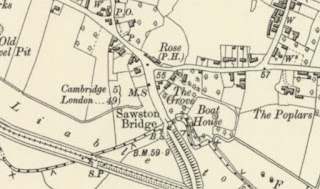
1888-1913 O.S. Stapleford
CC-BY-NC-SA National Library of Scotland

Apart from being Mildmay Preacher between 1816 and 1818, Christ's has no record of him holding a College office, or a benefice, or being resident in College, though he never missed a meeting until his last five years.  

Christ's College, Cambridge: Fellows' Garden, showing rear of Fellows' Building

How did he spend his time (apart from taking part in the College feud)?  He must have lectured, perhaps he had pupils and he seems, on occasion at least, to have taken duty for another clergyman.  He certainly farmed.  He had his library, which was a typical middle-class collection judging by the inscribed volumes that have passed down through the years – and Jane Austen would have been pleased to see that he didn't disdain novels.  He had Samuel Richardson's Sir Charles Grandison.  We can imagine him working away at the system of shorthand that he invented.  It was a quiet life.

Thomas Atkinson (1722-92), Master of Sir William Turner's Hospital, Kirkleatham

This follows on from the preceding post, The Atkinsons of Scaling Dam in the 17th & 18th centuries

Thomas Atkinson was born on Friday 13 April 1722, between 9 and 10 o'clock at Night.

We don't know where he was educated – perhaps in one of the Whitby schools – but he clearly was something of a mathematician (for example, his answer to a problem was printed in Miscellaneous Correspondence, in Prose and Verse Volume 4, 1764).

He married Elizabeth Featherstone (c1720-1805) on 21 September 1749 in Westerdale.  Elizabeth may have been the daughter of Peter Fetherstone, who was baptised on 2 February 1720 at Danby in Cleveland.

On 9 May 1751, when Thomas was 29, he took up the post of Master of the Blue Coat Boys at the Turner Hospital at Kirkleatham.  When he and his family moved into the master's house, the Hospital – which consisted of almshouses, boys' and girls' schools and a chapel – had only recently been extended and remodelled by Sir William's great-nephew Cholmley Turner.  Thomas must have been very pleased with his new situation.  He and his family stayed there for nearly 25 years.   

Sir William Turner's Almshouses by Mick Garrett

He was clearly an able and meticulous man, and in 1774 he drew up a map of the parish and manor of Kirkleatham for his employer.  So perhaps when he left Kirkleatham a year later at the age of 53, and went to Marske Hall on the Cleveland coast, it might have been to become steward for Lawrence Dundas.  Dundas was an ambitious and forceful Scottish businessman and politician who had bought the Marske Hall estate a dozen years earlier, at about the same time as he bought the Aske estate in Richmondshire.  

By 1788, Thomas was in retirement and he and his wife Elizabeth were with their son William in Whaddon in Cambridgeshire.  

He now had time to repair the family Bible that had been spoilt and defaced after his father's death in 1755, when it had been 

clandestinely taken away from my Mother, by one Hudson who had not the least Right or Pretention of Right to it; after having kept it several Years in his Possession, I obliged him to return it; but it was in such bad Condition by his writing his own Name a vast Number of times, and a Repetition of the Names of his Children and many Sentences too ridiculous to be seen in a Book of this Sort; I thought proper to cut out the Pages he had so Contaminated and to introduce several Leaves of fresh Paper in their Stead; whereas I shall transcribe such Particulars as my Father thought fit to leave on Record in this Book relating to our Family; and do hereby earnestly recommend this Book to the Care of my Children, that they never suffer it to go out of the Family for the future. 
Example of Thomas Atkinson's repair to the family Bible

Thomas Atkinson and Elizabeth Featherstone had 6 sons and 2 daughters:

  • Jane Atkinson, born 9 March 1751
    • on 4 June 1775 at Rotherhithe, she married Captain Thomas Galilee (1744-97) (for more on his family see here
    • they had 6 daughters who survived infancy: Mary, Elizabeth, Margaret, Jane, Harriet & Henrietta
    • Jane died on 19 December 1817 aged 66 and was buried at Whaddon, Cambridgeshire
    • for more on Jane and her daughters see later post, Jane Atkinson of Kirkleatham (1751-1817), wife of Captain Thomas Galilee
  • Isaac Atkinson, born 5 March 1757
    • was a London wholesale linen draper with premises in Cheapside, while living out of town in the country air of the parish of St Mary, Islington
    • he died aged 46 on 6 July 1803 and was buried with his father at Whaddon on 13 July 1803
  • Daniel Atkinson, born 7 February 1759
    • he is known to have married and had 3 children, because they are mentioned in his brother William's Will, made in 1828:
    • An undated entry in the family Bible says that Daniel himself "Died at New York"
  • John Atkinson, born 12 February 1761
    • an undated entry in the family Bible says that John died on the coast of Africa
  • Robert Atkinson, born 8 February 1763
    • he died in infancy and was buried on 14 June 1765 in Kirkleatham
  • Elizabeth Atkinson, born 18 February 1764
    • she was baptised on 29 Feb 1764 and died 3 days later.  Buried at Kirkleatham

Thomas Atkinson died on 1 February 1792 at the age of 70.  A note in the burial register records that he was "late of Marsk near Gisborough N Riding Yorks died at the Vicarage house at Whaddon Feb 1"

Thomas's son William wasn't the vicar of Whaddon, so that wasn't why Thomas was living in the vicarage house.  William isn't recorded as having held any benefice, and I think a Revd Thomas Wilson was vicar at the time.  According to the Victoria County History 

In the 1790s the vicar had only a room in an old cottage, probably the old vicarage, which was enlarged in the early 19th century, and again c1877  

Robert Hurlock, who succeeded Mr Wilson and was vicar from 1797 to 1852, also held Shepreth.  It must have been more comfortable at Shepreth before the Whaddon vicarage was enlarged, because by 1807 he was recorded as living at Whaddon.  So perhaps Thomas and Elizabeth were renting the old cottage that had been the old vicarage.

St Mary's Whaddon, Cambs by Alan Kent

Elizabeth survived him by 7 years.  She carried on living with her son William at Whaddon and it was there that she died on 19 November 1805 aged 85.  

Thomas and Elizabeth were both buried at Whaddon.  

Elizabeth had also outlived her son Isaac, who died aged 46 in 1803.  Though he lived in the parish of St Mary Islington, he was buried with his father at Whaddon on 13 July 1803.  Whaddon was to become the place of burial for all of the family who lived in Cambridgeshire:  Thomas and Elizabeth, their children Isaac, William and Jane, and their granddaughter Harriet.

When Stella Sterry visited Whaddon in 1970, she was able to read the inscriptions on the gravestones of Thomas, Isaac, Elizabeth, Jane and Harriet.  William's gravestone, with its Latin inscription, was not very legible.  

Excerpt from insert in Atkinson Bible