Saturday, 31 December 2022

A small tin box – a Teesside "garden city" – a house in Nunthorpe

Question:  what is the link between the small tin box of sweets and cigarettes given to soldiers and sailors in World War I – the Redcar suburb of Dormanstown – and the 'Red House' on Church Lane in Nunthorpe-in-Cleveland?

Answer:  they were all designed by the architects Stanley Davenport Adshead and Stanley Churchill Ramsey.

The tin: the Princess Mary Gift Fund Box

Princess Mary in 1932

In the autumn of 1914, the 17 year old Princess Mary – only daughter of King George V and Queen Mary – decided that she wanted to give every soldier at the front and every sailor at sea a Christmas gift bought from her own allowance.  It was a generous plan, but it was found to be unworkable and so it was decided instead that she should be the face of a fundraising campaign.  She wasn't simply a figurehead of the campaign – she was deeply interested in the project and followed it closely.  Her letter to the public says it all

I want you now to help me to send a Christmas present from the whole of the nation to every sailor afloat and every soldier at the front.  I am sure that we should all be happier to feel that we had helped to send our little token of love and sympathy on Christmas morning, something that would be useful and of permanent value, and the making of which may be the means of providing employment in trades adversely affected by the war.  Could there be anything more likely to hearten them in their struggle than a present received straight from home on Christmas Day?

Please will you help me?

The troops' present came in the form of a small, brass, water-tight box.  For most of the men, the box contained tobacco, cigarettes and chocolate but everyone was catered for – non-smokers, nurses, Gurkhas, Sikhs, other troops from India, authorised camp followers ...

Many men sent the boxes home as a present for their wives and families; many re-used and long treasured the empty tins.  This was the box kept by the Middlesbrough solicitor, Major Thomas Duncan Henlock ("Duncan") Stubbs, a Territorial officer with the Northumbrian (Heavy) Battery, Royal Garrison Artillery.

It's a small metal tin embossed with a picture of the Princess.  In the surrounding border can be seen the words 'Belgium', 'Imperium Britannicum', 'Japan', 'Russia', 'Montenegro', 'Christmas 1914', 'Servia' and 'France'.  

There had been no difficulty in raising the money.  In fact, so much was raised – mostly from the thousands of small donations sent in by ordinary people – that there was enough to include everyone wearing the King's uniform in Christmas 1914, prisoners of war and the next of kin of 1914 casualties.  There were more difficulties, in the conditions of war time, in sourcing the contents and enough brass to make the boxes.  Gift boxes were still being sent out in 1918.  The tins were designed were designed by the architects Stanley Davenport Adshead (1868–1946) and his partner Stanley Churchill Ramsey (1882-1968).
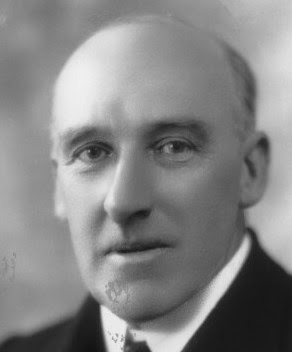
Stanley Adshead was the first professor of town planning in this country, appointed by Liverpool University in 1909, the year of the first Town Planning Act.  He took Stanley Ramsey into his practice as a junior partner in 1910, when the King had invited him to carry out a survey for the Duchy of Cornwall estate in Kennington.

Stanley Adshead in 1927

The Garden City of Dormanstown

In 1917 Messrs Dorman, Long & Co built their new Iron and Steel Works at Redcar.  

Dorman, Long & Co were steel manufacturers, bridge builders & constructional engineers.  An internationally significant company from the heyday of the Industrial Revolution, founded by Sir Alfred and his partner Albert de Lande Long in 1875, by the 1920s it would have over a dozen iron and steelworks across Teesside, together with mines and quarries, London offices in Westminster and Cannon Street, a wharf at Battersea, offices in Manchester, Nottingham and Calcutta and associated companies in South Africa and South America.  They built bridges across the Tyne, the Nile and the Limpopo.  They made the steel for bridges in India and Burma and for the Lambeth Bridge across the Thames.  

In 1917 the USA entered the war and an end to the fighting came in sight.  It was a time of great change – there was a huge shortage of workers' housing, the iron and steel industry was in flux, there were shortages of materials and labour, and people were beginning to look to the return of the troops.  Conscription had revealed the scale of the poor state of public health.  Electoral reform was on its way.  After the war, things would and should be different.  

Dorman Long wanted to give their workers a standard of life that wouldn't simply meet minimum requirements, but would 

encourage, develop and secure that spirit of loyal service and co-operation which is recognised by enlightened employers of labour as a vital factor in the success of industrial enterprise.

The company decided to build housing for its Redcar workers – a new "Garden City" or "Industrial Village" called, at first, Dormantown and then Dormanstown.

The chosen architects were Messrs Adshead and Ramsey together with Patrick Abercrombie.

Influenced by social reformers and commentators such as Florence Bell (1851-1930) whose At the Works had been published in 1907, and in collaboration with local and central government – particularly the Ministry of Health – and after consultation with the workmen, the architects' brief was to create healthy conditions for the workforce, in stark contrast to the insanitary, overcrowded conditions of much workers' housing on Teesside, where infectious disease was rife.  

The streets of Dormanstown would be wide – there would be trees and grass, shops and facilities, play areas and open spaces – and the houses would have front and back gardens, electricity, hot and cold water and an indoor WC and bath.

They were designed in the newly fashionable Neo-Georgian style, which blended the modern desire for simplicity and regularity with the traditional look of 18th and early 19th century housing.  White-rendered houses – mostly semis, but with some short terraces – with plain frontages, sash windows and six-panelled doors were built.  They echoed the Georgian architecture of local towns and villages such as Great Ayton, Guisborough, Yarm.  

Dorlonco houses under construction, Dormanstown 1920

The first 300 houses were built of brick, but then the authorities approved an experimental prefabricated construction using precast concrete and steel.  

This was Dorman, Long's own 'Dorlonco' system.  It was described in a newspaper article of 24 July 1919 

A steel frame is first set up on similar lines to the American skyscrapers, and on this is wired strong, rough netting, as a foundation for the concrete walls

The houses could be built by the company's own workforce with easily obtainable materials, and quickly.  A 2-tonne steel frame, pre-cut and prepared in the factory, could be put up by 4 unskilled men in a day.  And as houses were urgently needed across the country, Dorlonco houses were built by many local authorities until the mid 1920s.  

Unfortunately, things didn't work out entirely as planned.  Infectious diseases like scarlet fever, TB and diphtheria persisted – the people of Dormanstown were too much exposed to the noxious fumes from the steel mills and the raw damp from the sea – and the Dorlonco system had a flaw.  When the render shrank, it exposed the steel laths and rods, which had no protective bitumen coating, to corrosion.  At Dormanstown, built on low lying, marshy land near the North Sea, salt-laden air and driving rain led to rusting.

But in the early days this wasn't known and everything looked promising.  

In the spring of 1919, Major Duncan Stubbs returned from the war.  He chose not to go back into private practice as a solicitor, but instead to put his talents as an administrator and lawyer to work in industry for an old family friend, Sir Arthur Dorman.  On 13 May 1919, he became Company Secretary of Dorman, Long.  

Major Duncan Stubbs & a Dorlonco house under construction

The Red House, Church Lane, Nunthorpe

After the War, the Stubbs family returned to live at Red Croft on Guisborough Road, Nunthorpe, and they were living there when Dorman Long got the contract to build the Sydney Harbour Bridge.  

Sir Arthur Dorman

In fact, Sir Arthur Dorman was at Red Croft for tea with the family one day when the telephone rang.  Duncan's teenage daughter Katharine took the call.  The caller needed an answer from Sir Arthur – she took the message and Sir Arthur instructed her to make the reply, "Yes".  When she came back into the room, he told her that she had held the fate of the Sydney Harbour Bridge in her hands.  

Sir Arthur lived near Nunthorpe and he was the village's benefactor.  He had rebuilt the village school – the new church of St Mary the Virgin would soon be built on the lane that led to Nunthorpe Grange and Morton Carr farms on land given by him – and the houses that had grown up around Nunthorpe railway station were also his work.  His great house, Grey Towers, stood a little way from the station, in parkland near the old village.  A keen horticulturalist, he had built terraced rock gardens and in his woods had planted an example of every type of tree that it was possible to grow in England.

Duncan Stubbs planned to build a house for himself on Church Lane.

In 1922, he bought the land for his new house and he chose Messrs Adshead and Ramsey to be his architects.  Their Neo-Georgian style was fashionable for the new country houses being built for upper and professional middle classes.

The house would stand in a commanding position in the rolling North Riding countryside, with a view across fields to Roseberry Topping and the Cleveland Hills.  

His 18 year old daughter Katharine laid the first brick in the foundations of the north-west corner of their new house in March 1923.  Every detail of the house's design was attended to; Mr Ramsey even designed the light switches.  

The Red House, built of locally hand-made brick with a red-tiled roof, was designed to look mellow and serene from the beginning.  The drive curved down from Church Lane towards the front door between avenues of limes, and, so that the new house would not stand in a raw, barren landscape, these trees were planted before building even began.  

The Red House, 1924
with Alfred Leonard Hill's HE (Herbert Engineering) sports car

The rooms faced south to the sun and the view of the Cleveland Hills.  The grounds would include formal gardens, lawns, orchard, paddocks, tennis courts, a kitchen garden and a wild garden.   

The Red House

The house and garage, with a yard between them, formed one long block enclosed by a continuous external wall.  The entrance from the drive was given dignity and importance by a portico and distinctive circular windows to either side of the front door, but it was the frontage to the hills – so clearly seen across the fields from the Stokesley road – that was designed to be the more imposing.  

The house consisted of: dining room, inner hall (used as a sitting room), drawing room, study, 3 large bedrooms (the master bedroom had a dressing room and there was a dressing room for guests) and 2 smaller bedrooms.  On the second floor were the maids' bedrooms, reached by back stairs.  

The service end of the house, through the green baize door near the dining room, contained the kitchen, larder, butler's pantry, scullery and washhouse.  Beyond the kitchen was a yard with the coal store – deliveries were made through the double doors which can be seen on the photograph of the front of the house – and beyond it was the garage.

The impression on crossing the threshold was of light and air.  The front inner door was of glass and the view was directly through the inner hall towards the garden and hills.  The halls, dining room, drawing room and study all had oak floors and an impressive oak staircase led to the first floor.    

From the inner hall, a couple of steps dropped down to a terrace overlooking the hills and a further flight led down to the tennis courts.  There were kennels and garages, outhouses and two tennis courts.  The house had central heating, powered by a Robin Hood Royal boiler.  The design assumed an unending supply of cheap fuel and easily available domestic staff.

Stanley Ramsey (right)
at Katharine Stubbs' wedding
 
On 3 June 1924, the family moved in.  

Guests soon followed and the Visitor's Book shows that the first to arrive, in mid July, were the architect Stanley Ramsey and his wife.  Two years later, Stanley Ramsey was at Katharine Stubbs' wedding to Alfred Leonard Hill on 13 July 1926.

The Red House was an ideal house for entertaining.  

One of the earliest parties was described years later by Katharine

We gave a garden party for Dorman Long office workers to celebrate the Sydney Harbour Bridge.  Tennis (two courts) on the lawn and a room cleared for dancing indoors.  Buffet in the garden.  A lovely hot day

In 1931, Duncan Stubbs was digging a hole for the back gatepost when he had a heart attack; he died at the Red House a few days later, on 18 March.  He was buried in the graveyard of the new church, his coffin carried on a farm wagon from the house – the same wagon and the same horse that had taken the coffin of Sir Arthur Dorman a few weeks before.  As they stood in the churchyard, the family could hear Duncan's dogs howling at the house – somehow they knew their master was gone.


Note:  the original garage became a separate house some decades ago, and the house itself has been much altered over the years by successive owners

Sources

For Dormanstown, see Modernity, Tradition and the Design of the 'Industrial Village' of Dormanstown 1917–1923 by Cheryl Buckley 
Journal of Design History, Vol. 23, No. 1, Model, Method and Mediation in the History of Housing Design (2010), pp. 21-41 (21 pages)

The photograph of Stanley Adshead is by Bassano, the society photographer, and is in the National Portrait Gallery (NPG x124052)

Saturday, 29 October 2022

The Poltergeist at Moor Farm, North Yorkshire: 1940 to 1950

This is a record kept by Kay Hill of unnerving experiences in a moorland farm during and after World War II.

In 1938 Kay had become – in the slang of the time – a Bolter.  

She had left her very comfortable life at Carlton Manor, the country house set, the trips to London to have her hair done, the holidays abroad with her husband, the ironmaster and amateur racing driver Leonard Hill – and she had left her young daughter too – and she had run off to live with a local race horse trainer.

Kay Hill:  Filey 1939

At first they lived in Filey, where he kept his horses at Foords Hotel Stables and exercised them on the sands, but when war broke out and the beaches were closed, they moved away from the coast to live and work at a moorland farm.  

Racing continued through the war, though much reduced, because the government decided it was a boost to the country's morale.

I don't know that the current owners would want me to name the farm, so I haven't.  (Do contact me if you think you know which one it was).  And I didn't feel it right to identify Kay's partner and his sons.  I've called him Alfred and his sons Brian and Peter.  I knew Peter well; a lovely man.  The boys lived with their grandparents after they lost their mother when they were very small, aged only 2 and 4.  Kay was Katharine Stubbs, only daughter of Major Duncan Stubbs and his wife Madge Buchannan.

Kay refers to Alfred as "the farmer" in this account and she doesn't explain him at all.  This seems to be because she always intended to share the story, which she finally sent to the Incorporated Society for Psychical Research in 1977.  She kept her married name throughout her long life – she died aged 100 – she wrote under that name, and she was well known as Kay Hill in the world of Siamese cat breeding.

Her account begins in early 1940 when she was 34 years old and Alfred was 36:  

The Poltergeist at Moor Farm: 1940-1950

by Kay Hill

Moor Farm, painted by Kay Hill

According to accounts of poltergeists, including that of John Wesley's family, there is often a sound of flying & clucking & almost always someone in the house sees an animal such as a hare or a cat.  Children see it so often they have given it pet names; & this has happened in one generation after another for centuries past

References: "Poltergeists over England"  and "Poltergeists" by Sacheverell Sitwell 

War Years

Note

There was no electricity supply on the farms up the Moor Road until after the War.  
The blackout was in force and we had paraffin lamps and candles

When I first came to the farm in the late spring of 1940, I had my own furniture with me, and was given the choice of two rooms, as my bedroom.  I moved my furniture into the lighter of the rooms, and the other became the spare room.

Within a week of moving in, I had to make the enormous effort of changing over the furniture in both rooms.  It was a busy time of year on the farm, and I only had the Land Girl to help me.  My reasons for moving seemed ridiculous, and the whole thing was most unpopular.  I made an excuse that the room over the kitchen, which I still occupy, was the drier of the two; and after a day of violent effort I made my escape from the thing that had frightened me.

I had been woken up by the sound of something flying round the room, and could hear the beat of its wings.  I had the horrifying thought that it might be a bat, so I shone my electric torch, and the flying stopped.

As soon as I put the torch out, the flying started again.

I got out of bed, shut the window, and put up the blackout.  I lit the lamp and searched the top of the wardrobe, and all round the room, and under the furniture.  I opened the wardrobe door and shook the clothes.

When I went back to bed and turned the lamp out, the flying started again.  I was not at all afraid, but extremely annoyed at being kept awake.  I sat up in bed with my torch on the sheet, and when the thing was in mid flight switched it on.  The flying stopped instantly. 

The flying made a sound like the beating of wings of considerable power.  As when a woodpigeon passes low overhead at dusk, you can hear the air passing through the feathers of the wings.

This went on for some considerable time, until I lit the lamp, and went to sleep with the light on.

The next night it all started again, and continued in the same way for five successive nights.  By this time I was short of sleep, and rather frightened.  I talked about it to other people, but it sounded ridiculous and was put down to starlings, or rats, with which opinion I was inclined to agree; although I knew that I had not satisfied myself with such an easy explanation.

The last night in the room there was no flying.  I was kept awake by a carthorse on the road outside, which went up and down with a steady clop clop clop of hooves on the macadam.  I went to the window with the idea of going out and putting the horse back in the field.  I could hear no horse on the road, and our own horse was in the field near the water trough, a few yards from the house.  When I went back to bed the horse started walking again.  It was then that I realised that the sound was in the room – but like a ventriloquist throwing it about, so that it was impossible to tell from where it came.  

By this time the room frightened me, and I made up my mind to move, however much trouble it caused.  

From this time the noisy room became the spare room.  An endless succession of visitors slept in it.  My friend Mrs Macfarlane came for weeks on end, during the school term, & Brian the farmer's son came in the school holidays.  

No one ever made a complaint, and the whole thing was forgotten.  I never associated the sounds with poltergeists, because I thought of them as some sort of German forest thing, like an Irish leprechaun.  It was not until I read Sacheverell Sitwell's book on Poltergeists that I realised that the flying and the clucking were very ordinary manifestations.

When Peter, the farmer's younger son, first spent his school holidays at the farm, the whole thing was forgotten.  He was about thirteen years old, and was living with his grandparents during the time he was at Coatham School.

I found that he was burning candles in the night to such an extent, that I guessed that he was frightened.  As he had been badly bombed I put it down to this, and thought it better not to say anything to him.  At that time he was very much the ardent Boy Scout, and would rather have died than admit to any sort of fear.

I tactfully provided him with a box of nightlights and a saucer of water.  About this time he started taking the dog to his room at nights, and would search the farm rather than go to bed without him.  He was burning a night light through every night, and I began to be rather worried.

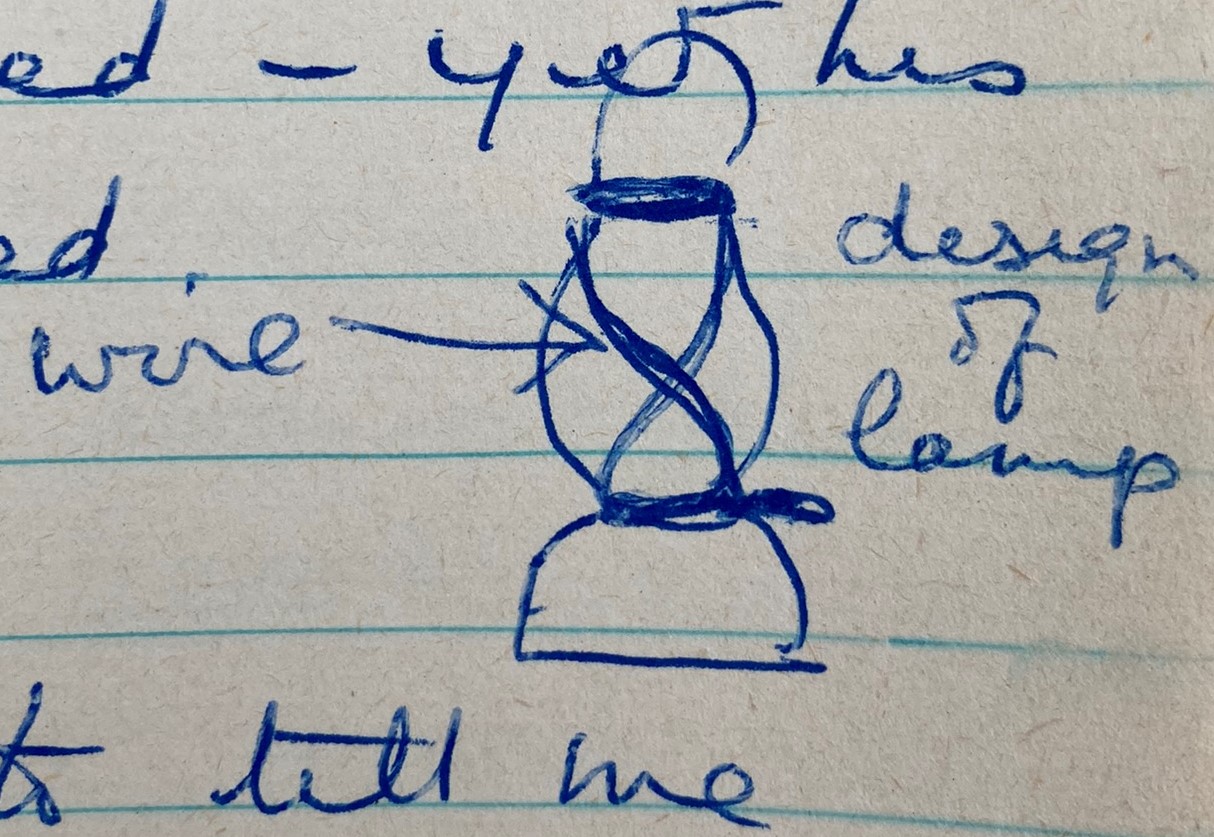
One morning he called to me, "Come and look at this."  I went into his room.  Down at the bottom of the bed by his feet were broken pieces of lamp glass and his leg was cut and bleeding.  There was a stable light standing upright on his chest of drawers minus its glass, but with the wire guard still intact around it.  It was the glass from this lamp down his bed – yet his hands were not marked.

Kay's sketch of the stable lamp

I decided to ask him to tell me his opinion of the matter.  He poured out a story of terrified nights when he dare not move in bed, because he knew there was something in the room.  Of sounds he could not account for – "I took Laddie to bed because when there was a queer noise, I would say "That was only Laddie.""

After this he was moved out of the room, and he shared a bedroom with his elder brother and there was no more trouble.

One thing that interested me – he never heard either flying or clucking.

Peter at this age was a violently active intelligent but unimaginative boy.  He never read a book, except on a technical subject, such as aircraft, motor cars, or horses.  He was extremely truthful, and would face punishment rather than tell a lie.  Since then he has become a very promising amateur jockey in point to points, and "over the sticks" and is physically afraid of nothing.  The only way in which I consider him unusual, is his intuition about people, which is sometimes so accurate as to be almost psychic.

By the summer of 1947 we had all decided that the poltergeist, if it was one, had gone for good.  Alfred (the farmer) was occupying the room, and had at various times slept with his door wide open "To let it fly out"; but he never would discuss the matter, and said that in any case he was not frightened.

At the time of the heat wave, he was away in Ireland.  I was changing the bed linen in all the rooms, and found that whereas my room over the kitchen was intolerably hot – the other room was cool.  That night I decided to sleep there.  I fell asleep not at all afraid, as it was midsummer and not dark.  I was awakened by a thunderous rap on the chest of drawers about a yard from my head, where the stable lamp had stood in Peter's day.  I did not wait for any more trouble, but went downstairs and spent the night on a sofa in the sitting room.  

In the past winter months we have had endless trouble, and a variety of manifestations which became more alarming.

Alfred reluctantly admitted that something flies; that it clucks "like a broody hen"; that it plucked at his sleeve – and gave him a sharp rap on the ankle in bed.  That it opens and shuts a door in the bedroom that isn't there, and lets in a draught.  As he sleeps with his door wide open I have at various times heard him say out loud, "Stop it" to something that is annoying him.  (He is so concerned with the horses in the yard he seldom sleeps with the door shut and seems to hear the slightest sound of anything wrong in the stableyard)

I always come out of the "ghost" room backwards, whether in daylight or at night.  I would never turn my back on that presence.  Peter and I are sometimes quite happy about going to bed, and sometimes dare not go upstairs even together.  One night I was asleep, when I felt a cat jump on my bed, and thinking it was my own, took no notice.  As I became more awake I remembered that my cat had run away months ago.  I lit a lamp, there was no cat in the room – the door was shut, and the window only open a fraction.  I called to Peter, and he came into the room.  As I was talking to him a loud wailing "Meow" came from under the bed, making us both jump.  We searched the room (which is tiny) but there was nothing there.

That was the first time we had a fright outside the usual room.  Then we both heard sounds on the landing from time to time, thumps, and a clicking noise like a parrot cracking sunflower seeds in its beak.

Sitting in the kitchen on winter evenings I frequently felt that I had just missed seeing a cat come from the bottom of the stairs and flash out of sight.

One night sitting with Peter, I saw him jerk his head round, and asked him what was the matter.  He said, "I just missed it, you know what I mean."

On one occasion when I said that I wished my cat were back to sleep on my bed and keep me company, he said, "They are no good – they are hand in glove with the other side; in league with it."

This remark coming from a boy of Peter's type is more impressive to one who knows him than to an outsider.

On the night of the Hurworth Hunt Ball early this year [1948], we were all dressed and ready to go.  Peter was in the kitchen, with the door at the bottom of the stairs closed.  I was in my bedroom with the door open, just ready to put the light out and go downstairs.  Alfred was in his room with the door open, and the light on.

There was a sliding sound on the banisters, and something that seemed like a heavy coat or a rug slid off and swished down the stairs, hitting the door at the bottom, bursting it open, and landing with a soft thump on the floor.

Peter called up to me, "What are you trying to throw at me?"  Alfred and I went out onto the landing to see what had fallen.  There was nothing to be seen either on the landing or at the bottom of the stairs.  Peter said the door flew open, and he heard something land on the floor with a thump.  The door has an old fashioned latch, and will not stay shut at all unless this is in place.  It is impossible to burst open.  (The door is tilted, like most of the house, and swings open into the kitchen unless the latch is firmly home)

One night I heard slow heavy footsteps coming up the stairs, as if someone were carrying a heavy tray.  I realised that Peter and Alfred had gone to bed when I did, and that both were in light slippers, and not in outdoor boots.  I dare not go out, or call out.  The footsteps went into the room with the open door called the attic.

In the morning both Peter and Alfred said that they had never been out of bed, and in any case their boots were downstairs.

Winter 1948.    A few weeks ago Peter and I were sitting in the kitchen listening to the racing results on the wireless at 6.25 (part of the job in a racing stable).  I had scribbled them down on a piece of paper, and he was checking them off from the runners in the daily paper.  We were both talking and laughing.

Suddenly he looked at me and turned crimson.  Then he said, "Stand up".  I stood up, and he stared behind me at the cushion at the end of the sofa.  He went white, and said, "A cat clawed itself on to the sofa and went across your knees to the cushion behind you.  It was a nearly white cat with tabby markings on its back and tail.  I didn't see its head because it was moving away from me.  I have just realised that we have no cat like that, and never have had."

At this time we were both shut in for a winter evening by the fire, and there was no cat in the room.  Neither of us was thinking of anything but racing, and I could tell by the colour of Peter's face that he was deeply distressed.  I felt nothing, and saw nothing.

Finally, a week or so ago, I was reading in bed.  Alfred was in his room and came into mine, saying "The damned thing is there."  My lamp was on a very heavy Victorian chest of drawers.  He had no sooner spoken than there was a terrific knock in the chest of drawers.  I said, "That sounded like a sledge hammer", and he said, "If you or I had picked up a hammer and hit that thing as hard as we could, we could not have made a noise like that."

The power of this noise was indescribable.  Enough to crack a chest of drawers in two.  Like a burst of thunder.  The flame of the light on the dressing table never flickered.

I have tried to trace the record of this house.  No one in the village has ever heard of it being haunted.  There is a farm record book, which people have seen, dating the house back to the 16th century.

Summing up

When I first heard the flying and the clucking I was one night alone in the house, and Peter was not there on any night.  The influence, whatever it is, comes and goes for no apparent reason, sometimes for weeks or months at a time.  The Land Girl never heard it.  Peter and I seem together to make it worse and together know when it has returned.  Someimes we have been afraid to go upstairs even together.

Alfred is not afraid but hates to talk about it.  If he can be persuaded to talk he admits its existence.

Peter tells me that when he slept in the room at the time the lamp glass was broken – he lay night after night rigid with fear and soaked in sweat, and convinced of a presence in the room.  He kept the light on, as he found that light put a stop to the thing.

1949

After the incidents in 1948 nothing happened, and it appeared that the trouble was over, and my account of it finished.

November 1949 – I heard someone feeling their way along the landing wall until they came to my door, when the groping (over the wood of the the door) changed its sound.  I thought someone was trying to go to bed without a light.  Went out, and no one was there.

A week after, the same sound halted at my door, and the feeble effort of someone trying to turn the brass door knob.  Like a child whose hands are slipping and very weak.  I was too frightened this time to go out.  I saw the handle turn half way several times.  Next morning took a look at door handle which is below door centre and possible for a child to reach.

Peter coming back from Bedale Hunt Ball 1949 saw lights moving in upper bedrooms.  I was alone in the house and in bed.  Had been terrified, and was awake when I heard the car come in.  I remembered then that on walking up from the bus in the dark I had seen lights on the ground floor pass through the 3 front rooms as if someone were carrying a faint lamp.  Was surprised to find front and back doors locked and the house empty.  I did not think much about this at the time, as hauntings were, I thought, over.

K I E Hill
December 28 / [19]49

There is no doubt that this winter the feeling is back again, but much fainter than before.  I am frightened to sleep alone in the house again, and scared of the room - although it is nothing like as bad as before.  The gropings at my door have shaken me, and I would not like this to happen if I were alone.  The thing was always malicious and rather evil.

Postscript

1950.  Had Brian staying.  Peter and I in kitchen doing racing entries.  Heard whispering voices arguing urgently and violently in next room.  They went on and on and we couldn't concentrate or catch what they were saying.  I shouted, "Will you two shut up" and dashed into the telephone room to slam the door.  No one there and Brian had gone with his father to the pub.

.........................................................

When Kay writes of the poltergeist in John Wesley's family, she is referring to the Epworth Rectory Poltergeist – cf Jeffrey the Jacobite Poltergeist: the politics of the ghost that haunted the Epworth Rectory in 1716-17  by Kelly Diehl Yates from the Wesleyan Theological Journal (2015).
It's fascinating and very readable.

The sounds of flying and clucking:  witnesses in the Epworth Rectory heard clucking and animal sounds among the thumps, raps, knocks etc, and one witness saw a rabbit-like creature.  They grew used to their visitation and 7 year old Kezzy used to have a game of chasing the noise around the house. 

The books which Kay quotes as references are:
  
Poltergeists over England by Harry Price (1945).   Harry Price was famous for exposing fraudulent mediums and is best remembered for his investigation into the Borley Rectory haunting

Poltergeists: An Introduction and Examination followed by Chosen Instances by Sacheverell Sitwell (1940). With decorations by Irene Hawkins and silhouettes by Cruikshank.  Written to entertain, it was reviewed in the Aberdeen Press and Journal of 19 July 1940, which hailed Sitwell's "benevolent intention of distracting his readers' minds from present preoccupations" and said "as an 'escape' volume we have not seen its equal this war"