Saturday, 28 October 2023

Dark nights in Great Ayton: 1889

This sad little story is a reminder of village life before street lighting.  We are so conscious of light pollution nowadays, we can forget the hazards of the past.

That admirable woman Mrs Annabel Dott wrote on the subject after her experiences among the rural poor of Dorset during the First World War.  She had been shocked and dismayed by their conditions and wrote about it in 1919 with great feeling.  Being a practical person, she saw where matters could be improved and one issue was lighting: 

Lighting is another important rural matter.  The dark roads make traffic difficult if not impossible after sunset, and during long evenings when there is no moon it is not an easy matter for old people, women, or delicate folk to get about.  One of the attractions of the town is the brightly lit streets ...
Joseph Longstaff was a Great Ayton man born and bred.  His father John had been a weaver and the parish clerk, and Joseph became parish clerk in his turn.  He began his working life as a tailor but for many years ran the village Post Office, with a grocery shop alongside.

In 1889 he was 69 years old and working as a tailor again and as assistant overseer for the parish.  He lived with his wife Mary and 11 year old son Edward on the High Street.

Northern Echo, 25 October 1889

Missing from Great Ayton

Considerable anxiety is being felt at Great Ayton on account of the mysterious disappearance of the Clerk of the Parish (Mr Joseph Longstaff).  

It appears on Friday evening he left home in his slippers and never returned, and nothing has been heard of him since.  The night was excessively dark, the weather tempestuous, and an unusual amount of water was rushing down the River Leven, which flows through the village.  It is very much to be feared that he has missed the bridge and fallen into the water, in which case the body would probably be carried for miles, so strong was the current at the time.  

Mr Longstaff was an old inhabitant of Ayton, and much respected.  He was for many years postmaster.  The village is in total darkness during the evenings of the winter months.

This wasn't the only tragedy that autumn, and the question of lighting was clearly on people's minds.  This happened less than a week later:

Daily Gazette for Middlesbrough, 31 October 1889

Another Fatality at Great Ayton

Some time during last night Henry Peacock, late stationer and newsagent, was drowned in the River Leven at Great Ayton.  His body was found early this morning under the stone bridge.  His death furnishes another sad argument for the necessity of lighting up the village. 

For a while the problem was solved and the village was lit by gas but, in the summer of 1896, the Friends' School changed to electric lighting, the gas works were discontinued and the village was dark again.  

At the beginning of the new century, several town councils were experimenting with a new invention called the Kitson Lamp, which was invented by Arthur Kitson, an Englishman who had moved to the USA.

His lamp used petroleum and a carbon mantle similar to those used in gas lamps.  The petroleum was held in a metal reservoir some distance away and drawn up to the lamp under air pressure through a very fine copper tube.  When it reached the part of the tube that was inside the lamp, the heat of the mantle vaporised it and was lit by an ingenious device that did away with the need to climb up to the lamp on a ladder.  As only a very minute quantity of oil was subjected to heat at any one time, even if the tube was broken there was no chance of an explosion.  

It was described enthusiastically in the press as a brilliant and beautiful light, the nearest approach to pure daylight and more pleasant to the eye than electric light.  Not only that, but it cost under a penny an hour and no underground plant or digging up of the streets was needed.  The gentlemen of Great Ayton decided to install one:

Daily Gazette for Middlesbrough, 6 March 1901

The Lighting of Great Ayton

Mr Henry Richardson and Mr Thompson, trustees to the manorial rights of Great Ayton, have, with other local gentlemen, aided Mr John Dixon to place on the High Green at Great Ayton a Kitson patent 1,000 candle-power lamp.  The lamp lights the whole of the green, and has been so successful that it is hoped that before long the whole village will be illuminated.  

Since the gas works at Great Ayton were discontinued on the Governors of the Friends' School having electric light instituted the village has had no illumination at all.  It is hoped by the tradesmen and inhabitants generally that a number of the lamps will be procured not only to light the road as far as the stone bridge, but also for California.

Saturday, 22 July 2023

Defective bottles at Seaton Sluice: 1835

A chance find which has turned up among my family's papers – a furious letter about defective bottles.  No idea how it ended up in a solicitor's offices in Middlesbrough …

On Thursday 23 July 1835, a young man called John Latimer Nichol dashed off an angry letter to a Mr John Jobling of Seaton Sluice, the busy little port close to the village of Hartley in Northumberland.

John Latimer Nichol was a 28 year old merchant, born in Gateshead and working in the City of London.  Among their other business ventures, he and his father Anthony Nichol were in partnership with Ingleby Thomas Miller from Shincliffe, Co Durham as Nichol & Miller, bottle merchants in London.  New stock for their warehouses was shipped in bottle sloops to their premises at Dowgate Wharf on the Thames, near today's Cannon Street Station.  There was a booming market for bottles in the capital.

Nichol & Miller's bottles came from the North East, where the vast majority of glassmaking was carried out – there were bottleworks on the Rivers Tyne and Wear and the Northumbrian coast, supplying customers across the world.  

The region had all the advantages of cheap coal for the furnaces (glassmaking was a very convenient sideline for colliery owners) together with established shipping routes and easy availability of raw materials.  In 1790, the North East mostly made wine and claret bottles but when, during the 1820s, bottled beer began to be exported to hot climates, the manufacturers began to produce beer bottles.  


It's possible that Nichol & Miller dealt exclusively with the bottleworks at the bustling seaport of Seaton Sluice, acting as their London outlet.

John Jobling, who would soon receive this angry letter, came from a family that was of very considerable importance in Seaton Sluice.  He was the son of James Jobling who, in partnership with John Carr, had been running the Hartley coalmines since 1809.  They had prospered and, besides their collieries, brewery and malt kilns, Mr Jobling and Mr Carr had taken over the Hartley Bottleworks in 1820.  

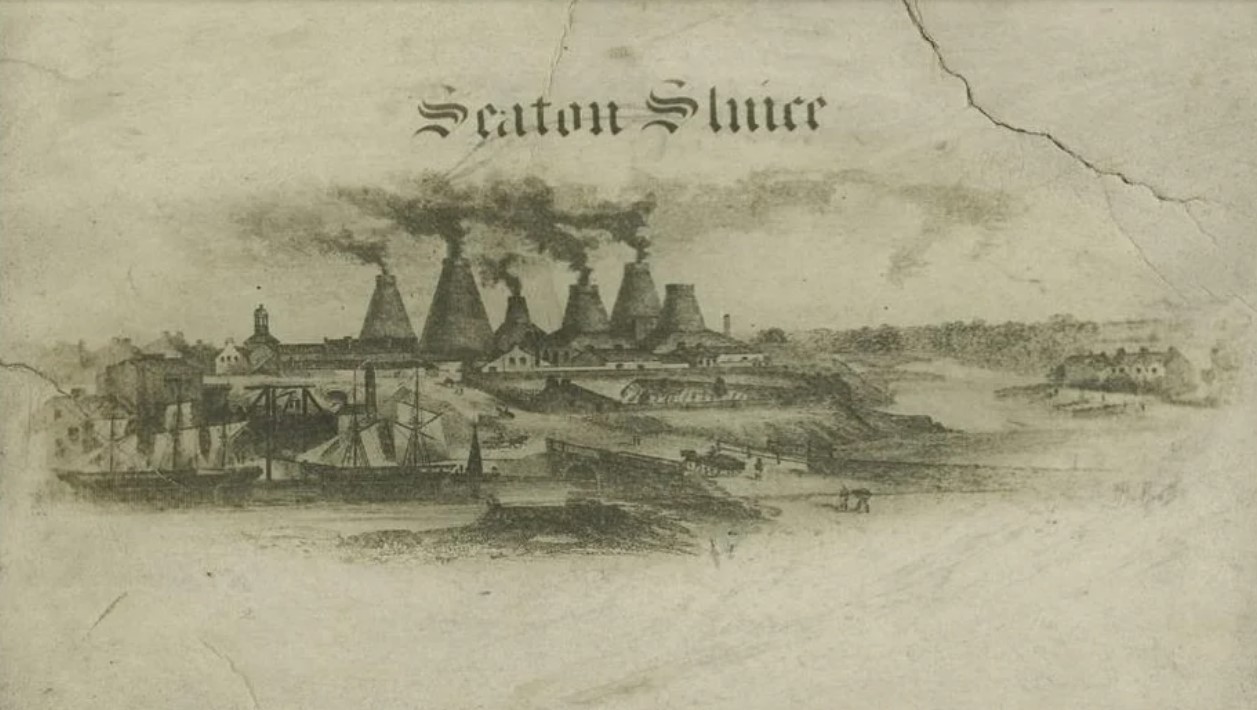
The works had been founded at Seaton Sluice by Thomas Delaval in 1763 and had swiftly grown into a huge concern – production had reached 1,740,000 bottles a year by 1777.  The following year, the first of three cone-shaped bottle houses was built to replace the old square buildings, their more powerful draught enabling more efficient furnaces.  There would be six of them eventually, dominating the skyline for the next 150 years and useful as sea marks to sailors. 

Seaton Sluice:  OS 1896 
CC-BY National Library of Scotland

In 1835 John Jobling was agent for the bottleworks of Messrs John Carr & Company.  Aged 42 and unmarried, he lived with his widowed mother and spinster sisters at the large, thatched Jacobean house called Seaton Lodge.  

This was originally the home of the Delaval family and was later occupied by the Delavals' land agent.  It was a picturesque old house, described in John Robinson's Illustrated Handbook to the Rivers Tyne, Blyth, & Wansbeck in 1894 in glowing terms – this was 22 years after the bottleworks and its smoky chimneys stopped work:
The situation of the house is all that can be desired, sheltered on all sides from the storms of the coast, the views from its windows up the charming dene, the sheet of water flowing in front of its terraced walks; while behind is one of those old fashioned gardens which delight the eye of all lovers of romantic landscape gardening.
Seaton Lodge from A History of Northumberland 1893

John Latimer Nichol wrote in such haste that his handwriting is a scrawl and he made a mistake with the date, giving it as 23 June 1835.  (It looks as though a later hand, possibly that of John Jobling himself, has corrected this to 23 July).  The letter was posted that very day and is marked

Z
JY 23
1835


He had just returned from a meeting with an important customer, who had sent for him to explain why they wouldn't be buying from Nichol & Miller in future.  John Latimer Nichol couldn't blame him.  He had been shown the product of one of his major rivals, and the difference in quality between Jobling's bottles and those bought from Cookson & Coulthard of South Shields was all too obvious.  Jobling's goods were not only inferior in colour and finish, but they were noticeably lighter and they gave way "at the shoulder".  John Latimer Nichol wrote bitterly, 
It is of little use our holding a stock of bottles which is only saleable till Mr Coombs or Mr Coulthard walk in & shew theirs
This was the third large business house whose custom they had lost and he wasn't going to order from Seaton Sluice again unless John Jobling could assure him that they would match the quality of bottles from Cooksons of South Shields and from Ridleys of Newcastle.
 
He asked John Jobling to meet his father Anthony Nichol in Newcastle to see 
if some thing cannot be done to meet our opponents in this matter for I have no fancy for carrying on my business at a rivals sufferances

This is John Latimer Nichol's letter – in some places I have had to make a guess at a word, and I've marked this with square brackets.