Sunday, 13 July 2025

John Wrightson, the Wise Man of Stokesley

In the days when people were nervous of witches, and called on the wake-wailer to come each evening before a funeral to sing the lyke wake that would keep their loved one's body safe from demons, they also had another resource – the Wise Man.  The wise man could be consulted for many problems – illnesses, lost and stolen goods, help in time of need, and to turn away witches' charms.

The most famous in Cleveland is undoubtedly John Wrightson, the Wise Man of Stokesley.  He was at the height of his fame at the end of the 18th and the beginning of the 19th centuries, at the time of the French Revolutionary and Napoleonic Wars.  This was a time when nobody was left unaffected by the huge demands of the war.  The wartime economy, the press gang, the militia and the army, the disruption of trade and manufacturing and the effect on people's livelihoods gave rise to uncertainty and many great hardships [1].  

So it is hardly surprising that John Wrightson should have a fertile field in which to work.  As to what he actually did and how he did it – writers over the years had various opinions on this, while there has always been an audience for the stories of his amazing feats.

Opinions on John Wrightson

Richard Blakeborough
Richard Blakeborough (1850-1918) was a writer, publisher, actor, playwright, recitalist and entertainer, in great demand at concerts and at house parties, where he was a favourite of fashionable audiences.  Born in Ripon, his passion was for the folklore and dialect of his native Yorkshire.  He began collecting during the time he worked in Bedale as a jeweller and watchmaker between the early 1870s and 1882 when he recorded many stories and dialect words which would otherwise be lost to us [2].   Born a couple of years after the railways reached Ripon, in the year that ironstone was discovered in the Eston Hills, he lived in the age of empire, of Disraeli and Gladstone and the might of industrial Britain.  He wrote with affection and enthusiasm of the world before industrialisation and compulsory education and he had a love of the mysterious and magical.  For him John Wrightson was "undoubtedly a man endowed with marvellous psychic power, and with the smallest amount of charlatanry possible" [3].

He relates in Wit, Character, Folklore & Customs of the North Riding of Yorkshire a couple of the stories that he was told.  

The first was a tale told him by William Scorer, who came from Baysdale and was landlord of the Fleece in Bedale during Blakeborough's time there.  The buyer of some cattle at Northallerton fair had engaged an old drover to drive them to Stokesley with the beasts he was taking for another buyer.  In the morning two of his cows were missing from the field near Stokesley in which the drover declared they had been gated the night before.  The buyers decided to consult the Wise Man, but also to test him by saying that it was a horse that was missing.  As they entered Wrightson's house, before a word had been said, Wrightson called from the scullery where he was washing himself
Noo then, if you chaps is sharp eneaaf, an' ez that mich off [ie. know that much] 'at ya can manish ti to'n tweea coos intiv a hoss, it's neea ewse cumin' ti me, foor Ah can't to'n a hoss back inti tweea coos, an' seea ya'd better mak yersens scarce.  Ah've nowt ti saay ti ya.
In the end he was persuaded to answer, and he told them that the cows were in the beck – where, indeed, they found them.  The cows had missed the bridge as they were driven over the Leven late at night and fallen into the swollen river. 

Saturday, 12 July 2025

Thomas Wayne (1727-1806) and the "Mystery of Angrove Hall"

In the 1990s Peter Meadows was working on an article on the subject of a lost Cleveland house called Angrove (also Anngrove or Ann-grove) Hall, which once stood between Great Ayton and Stokesley.  The results of his work were keenly anticipated but, as far as I can tell, it was never completed.  His draft article was the basis of Dan O'Sullivan's piece on Angrove Hall on the Great Ayton History Society pages on wikidot (and is now on the new Great Ayton History Society website) and I was given sight of the draft article many years ago by Dr Geoffrey Stout, but I have not been able to discover whether the draft article itself survives.  Finally I decided to investigate Angrove Hall myself and the account that follows is the result [1]

Richard Blakeborough's ghost story

On 11 August 1900 the Northern Weekly Gazette proudly announced that Mr Richard Blakeborough, "the well-known author of 'Yorkshire Wit, Character, Folklore, and Customs' and 'T'Hunt of Yatton Brigg'" would be contributing to the newspaper 

a series of unique complete stories, into which he has woven in his own inimitable way a variety of remarkable

Old Legends, Folk Tales,
and
Ghost Stories of North Yorkshire
under the title "Tales our Grandfathers Told"
On 25 August 1900, Richard Blakeborough's column began with a story of some 3,500 words entitled 'The Mystery of Ann Grove Hall' with the subtitle in brackets '(The Manor House, Stokesley)'.

Blakeborough's story was an exciting tale featuring in swift succession: a master of Angrove Hall who was enraged by the suspicion that his daughter planned to elope with the undercoachman; his allegation that the man had stolen valuables that he was entrusted to take to Stokesley; the disappearance of the coachman and his reappearance as a ghost; the hunt by the man's tenacious sister for the truth of her brother's fate with the aid of the witch Hannah Waugh and the Great Broughton blacksmith; and the exposure by means of magic charms of the master as a murderer.  The man's body is at last discovered and the Hall decays, falling 
into such ill-repute that no one could be prevailed upon to live in it, so it was closed, and never inhabited again, thus fulfilling the prophecy, which Hannah Waugh is reported to have made to the master of Anngrove, one day when she met him in Stokesley town, he being in company with several others at the time.  Said she, brandishing her staff in his face 
Thoo'll a'e thi day,
Bud lambs 'll plaay,
An' loup on t'grund where Anngrov' stan's.
Neea lahm (lime) s'll ho'd
S'all hap up t'deed o'thi tweea han's
Indeed, Blakeborough wrote, Hannah Waugh's prediction had come true and "not a stone" was left of "the ill-fated Manor House, Anngrove Hall".

By the time he repeated the story in his column in the Whitby Gazette on 1 December 1905, he had made the tale still more exciting and lively with the addition of a great deal of the dialect speech for which he was famous.  He also made a small change in the name he had given one of his characters.  In his original version he had given the name Thomas Mease to a groom at the Hall.  Possibly it had been pointed out to him that Thomas Mease (1792-1862) had been a well-known Stokesley business man as he has altered the name to Thomas Moses.

Three farms (Angrove East, Angrove West and Angrove North) preserve the name of Angrove today.  Its gate pillars can still be seen, as they were moved to the entrance to Stokesley Manor House when Angrove Hall was demolished 2.  (The date of the demolition is generally accepted to have been 1832, as given by Peter Meadows and as stated in Dan O'Sullivan's article.)  Richard Blakeborough's ghost story is still retold, and versions can be found online.

So what was the history of Angrove Hall?  And what relation does the ghost story bear to that history? 

Richard Blakeborough informed his readers that details of the murder and Angrove Hall itself were hard to establish.  Some old people believed that the murder happened in about 1840; some said it took place "quite a hundred years (say 1725) before the place was allowed to fall into ruin".  Some said the body was soon discovered; in the version he favours, the action plays out over generations.  Certainly Blakeborough knew little about the house, believing that it was an old manor house and referring to it as the Manor House of Stokesley.

In fact, Angrove Hall was only built in about 1760 and had a lifespan of barely 70 years.  Its owner and builder was called Thomas Wayne.  

Saturday, 3 May 2025

The Story of the Letters: Kay Hill & Michael Joseph

Katharine Hill (1905-2005) was very much of her time.  A young woman who grew up in a professional middle-class family and among the Teesside ironmasters and gentry, after the First World War she loved racing about the countryside in her friends' fast cars, astonishing the locals when they appeared at village hops and danced the Charleston.  She was married all in lace at St George's, Hanover Square to a kind and gentle, and also wealthy, friend of her brother.  And then she became the classic character of the time – a "Bolter".  

In 1937 she ran away (literally) from her husband and child to join a local racehorse trainer.  She left behind the world of racing cars, parties and going to London to have her hair done, and took up life near Thirsk at a racing stable and farm, breeding poultry and Siamese cats.  

Of an intensely romantic nature, she had a deep love of history and a great facility for writing.  Her stories and anecdotes of the past are vivid and fluent – though they can't quite be relied upon for accuracy.  

She never expected monogamy from herself or the racehorse trainer, and indeed they parted in the end and she lived in a caravan on his farm until her mother's death left her enough money to buy a cottage.  Her last years were spent contentedly at Omega Barns Retirement Home where the many dogs and horses made her very happy until her death at the age of 100, outliving her contemporaries in spite of smoking heavily for some 80 years.

During the Second World War, Katharine began a love affair with the publisher Michael Joseph (1897-1958) and at some point, writing in the third person, she wrote an account of their time together.  The photocopy which I found among her papers is apparently still unfinished and the whereabouts of the original are unknown, but all the same the draft story has such charm and is so redolent of its time that I thought it deserved a place here.  

Katharine, who was my great-aunt, on her death left Michael Joseph's letters to a novelist friend.  "Many letters are lost.  Some fell to bits with being carried about," she wrote.  She wanted her friend to use the letters in some way and for the story to be known, but the copyright in the letters remains with Michael Joseph's family until 70 years after his death and that time has not yet come.  In the meantime, and in case the letters are never made public, here is Kay's story. 

The Story of the Letters: Kay and Michael

A few days before Xmas 1943, Kay's Siamese cat died.  She had nursed it day and night and went down, exhausted, with influenza.  

On Xmas day, in bed with a temperature, she unwrapped a Xmas parcel which revealed a book Charles by Michael Joseph [1].  The sight of it was unbearable.  Seizing a pen & with temperature soaring, she wrote in her grief and rage to Michael Joseph.  "I did not know whether to read your book or throw it unread into a furnace."

He replied and when, in calmer mood, she wrote to thank him he sent her a parcel of books including Eleanor Farjeon's Golden Coney [2].

She returned the books and to her amazement got another letter.  So it started & so it went on.

They found themselves falling in love by letter and before they ever met were writing ardent love letters.  The war came to an end and with it the terrible fact emerged that they could meet and so bring about either the destruction of something rare and sweet or its fulfilment.

He was living in Richard Llewellyn's[3] flat in Upper Brook St when in London.  His secretary managed to find the impossible, a room in a London hotel nearby.  (No guests allowed to stay for more than 3 days, such was the scarcity of accommodation among the bombed houses.)

All the way to King's Cross at every stop Kay's impulse was to leap from the train and go back.  She had deliberately described herself as less attractive than most men had found her.  She was to be wearing a slate blue suit and to be carrying a rawhide suitcase.

In fact she had bought some clothing coupons and was wearing a tawny Donegal suit and carrying a brown suitcase.

They were to meet "at the bookstall" at King's Cross.

Michael Joseph by Howard Coster,
1938, NPG x1943
Kay stood there and saw him.  She was petrified, unable to move.  He did not recognize her and went round and round the bookstall searching.  She then went to the taxi queue, as instructed to do if he did not turn up) and there he saw her and pounced.

They went to Upper Brook St for lunch, then to her hotel where she changed and bathed.  From there they dined at the CafĂ© Anglais and that night she never returned to her hotel to sleep.  She managed to get her room booked for a further 3 days although she used it only for changing and resting in.

They wrote to each other until they met again and after they had met for the last time, before his last marriage, up to the day of his death.

They met in all for 15 days out of their lives.  "You always call it fifteen nights," he said.

They decided that marriage was not for them even when both were free.  Kay thought herself "unmarriageable" without maternal instinct, especially for step children, and loathed the housewife role.  He needed all these things in a wife – but not a mistress.  He was incapable of fidelity.  So, on the whole, was she.  He had a feminine, cruel streak, in spite of war service and a fondness for sport including amateur boxing, and considerable toughness of character and appearance.  She had a masculine streak with not a vestige of maternal instinct or domesticity.  They met on both levels.

Before he married again he wrote and asked her up to London.  She refused, without knowing, but sensing, what was to happen; considering it to be a typical instance of his "feminine" side.  To betray his future wife and cause his mistress to suffer 

Soon after he wrote a tender and loving letter telling her he was to marry.

She was seriously glad for his sake, glad too that their love affair had never tailed off into indifference, glad for a clean break.  She told him so, and parted.

A fortnight after his marriage he wrote, to her staggered surprise, and said that the honeymoon had been much less boring than he'd feared and he looked forward to happiness.  They went on writing but never met again.

Kay woke up one morning dreaming happily, half asleep, of the absurd meeting at King's Cross, which she had not thought of for years.  Still smiling, and with eyes, half closed, she leaned out of bed and switched on the BBC news.  A voice announced "the sudden death of Michael Joseph".  His last letter still unanswered.

Kay Hill at harvest time
c1950s


Notes

[1] Michael Joseph (1897-1958) was a few years older than Kay.  Charles was about the life and death of his Siamese cat and is now only available second hand.  It is described on this Pet Histories blog  here 
  
[2] Michael Joseph published Golden Coney – a novel by Eleanor Farjeon (1881-1965) about a cat – in 1943

[3]  The best known work by Richard Llewellyn (1906-83) is his novel How Green was my Valley (1939), which was made in 1941 into a Hollywood movie directed by John Ford


Tuesday, 8 April 2025

The Bathurst Charity School in Hutton Rudby

The connection between Hutton Rudby and the Bathursts began in the first half of the 17th century with the founder of the family fortunes, Dr John Bathurst.  

Dr John Bathurst (d 1659)

By the time he died in 1659, the eminent physician Dr John Bathurst [left] was a very wealthy man, whose estates were said to have been worth £2,000 a year.  The date of his birth is unclear [1].  According to the Dictionary of National Biography, he was born in Sussex and came of a Kentish family.  A reviewer of a history of Richmond and Swaledale in the Yorkshire Archaeological Journal [2] in 1979 described him as "one of the most famous of the Old Boys of Richmond Grammar School".

On 27 January 1636 (recorded as 1635 at the time, when the calendar was still in the Old Style) he married Elizabeth Willance at Marske in Swaledale.  Elizabeth and her sisters were the heiresses of their father Brian Willance of Clints Hall and shared his estates between them.  As a result, by his marriage Dr John Bathurst became the owner of Clints, a few miles from Richmond.  

Little is known of Elizabeth's father but her great-uncle, the draper Robert Willance, is one of Richmond's celebrities.  He was nearly killed when his young horse spooked and sprang down the cliff at Whitcliffe Scar, killing itself and breaking its rider's leg.  Famously, Willance saved his own life by cutting open the dead horse's belly and putting his broken leg into the carcass to keep himself warm and alive until help finally came.  His leg had to be amputated, and is said to have been buried in Richmond churchyard where its owner joined it years later.  Willance marked the spot on Whitcliffe Scar – Willance's Leap, as it is known – with a stone in thanksgiving for his preservation from death.  

In 1644, in the early days of the Wars of the Three Kingdoms, Dr John Bathurst was in practice at York where he successfully treated young Christopher Wandesford from Kirklington near Bedale who had been left in a pitiable state from the trauma of his father's death and funeral in Dublin.  Christopher was from a Royalist family;  Dr Bathurst's most celebrated patient was Oliver Cromwell himself.  

In 1656 Dr John Bathurst represented Richmond in the parliament reluctantly called by Cromwell (the Second Protectorate Parliament) and in 1659 when Oliver's son Richard Cromwell called the Third Protectorate Parliament, Dr Bathurst again represented Richmond.

He made his Will on 23 April 1659, the day after that parliament was dissolved and he died three days later.  

His family would benefit for the next hundred years from the fortune he had accumulated and the investments he had made.  Above all, they drew their wealth from the Arkengarthdale lead mines, where the well-known CB Inn is named after his descendant Charles Bathurst.  He had taken a lease on the mines in about 1650 and by 1656 he had bought the whole of the dale and the mining rights from the Crown.  

At his death he owned property in Swaledale, Richmond, London and Cleveland, including the manors and estates of Skutterskelfe and the nearby hamlets of Thoraldby and Braworth.  In his Will he established a charity in Richmond to maintain two poor scholars at Cambridge and to put out every year a poor boy as an apprentice, and among his charitable legacies he left a rent charge of twenty shillings on his manors to be paid by the churchwardens of Hutton Rudby to the poor on 20 December every year [3].

Monday, 11 November 2024

HMS Aboukir, Hogue and Cressy

I've only just caught up (two years late) with reading this excellent book on the sinking of HMS Aboukir, Hogue and Cressy on 22 September 1914 by a single German U-boat.

Stuart Heaver's 'The Coal Black Sea' is a vivid account of the disaster, with plenty of naval detail (the author was a navy officer himself) to engross those interested in the sea, and a full account of Winston Churchill's role and the political spin that followed the losses. 

Not to be missed by anybody interested in the First World War.

Klaudie Bartelink's poignant film about the cruisers, with amazingly beautiful footage of the wrecks, can be seen at

https://www.dutchmaritimeproductions.com/portfolio-item/live-bait-squadron/


Saturday, 28 September 2024

Charles Dickens' elder sister Fanny

This is an article from my blog The Engineering Hopkinsons.  It is set in Manchester and it's called 

'Henry Burnett & Fanny Dickens at the Rusholme Road Chapel'

The unaccompanied hymns at the Chapel (see The Rusholme Road Chapel & the Rev James Griffin) had always been plain and hearty, led by a rudimentary choir.  But at the beginning of the 1840s two musicians, fresh from London and the stage, had joined the congregation and, as their contribution to church life, formed a new and inspiring small choir to lead the singing.

They were Henry and Fanny Burnett, the two young people mentioned in the chapter 'Becoming a member of the Rusholme Road Chapel'.  Theirs was a world beyond John Hopkinson's imaginings.  He was 59 when he first went to the theatre in 1883 and seemed to his son and daughter-in-law to be fairly baffled by it, while his wife dared not tell his sister Elizabeth, "she would have been so shocked."  

Henry and Fanny Burnett came to Manchester after the baptism of their second son in London in the middle of May 1841.  Three or four weeks after settling in, they were walking along the Rusholme Road one Sunday evening when they saw the lights of the Chapel and the people going in.  They followed and were shown to seats.  Something – they could never say exactly what it was – impressed them deeply with the earnest wish to come again.  At the end of the service, Fanny had turned to Henry and said, "Henry, do let us come here again: if you will come, I will always come with you."  He was quite taken aback because she had never said anything like this before.  

For him, a Nonconformist service was a coming home.  He had been an acclaimed and successful operatic tenor, trained in music from an early age – at the age of ten he had stood on a table to sing a solo in the Brighton Pavilion to the Court and seen the old king George IV, gout-ridden and wrapped in bandages.  But though his father had been persuaded by a friend that the boy's voice was too good to be wasted, that he could make an excellent living from it, it was reluctantly because theirs was a Nonconformist family.  Henry had lived until the age of seven with a pious grandmother and aunt and their early teachings left a lasting impression on him.  And so his success in the world of music had become less and less fulfilling.  He was, as Mr Griffin wrote in his memoirs

gradually coming to feel the emptiness of worldly pleasure, and to yearn in his "secret heart" after more substantial satisfaction

In the end, he could no longer bear the contradiction between the life he was leading and what he felt to be right.  He decided to leave the stage and make his living from teaching.  He and his wife were advised that Manchester was the place to go, as music was highly appreciated there.  

Fanny Burnett wrote to Mr Griffin in these early days that 

I was brought up in the Established Church, but I regret to say, without any serious ideas of religion

but of that evening in the Rusholme Road Chapel, she said 

More or less all through the service, I seemed in a state of mind altogether new to me; and during the sermon it was as if I were entering a new world.

Her old world had been very different.  She was the elder sister of Charles Dickens.  In the Rev James Griffin's description of her new life in the chapel we can see the distinctive world of John Hopkinson and his family.

Fanny Dickens, 1836

Fanny (1810-48) and Charles (1812-70) were born in Portsmouth, the first of the large family of John Dickens, a pay-clerk in the Navy Pay Office, and his wife Elizabeth Barrow.  

In 1822 John Dickens was posted to London where Fanny was one of the fortunate children to get a place at the newly established Royal Academy of Music at its opening in March 1823, where she studied piano and singing.  The fees were 38 guineas a year, which wasn't cheap – as is recorded in A History of the Royal Academy of Music (1922), one of the committee members wrote to another, "we find that there are a great many schools where children do not pay so much". 

At this point, her parents' Micawber-like attitude to money, their habit of living beyond their means, caught up with them.  In September 1823, to save school fees and boost the family finances they sent their bright little 11 year old boy Charles to work in Warren's boot-blacking factory at Hungerford Stairs, an experience which Michael Allen has shown lasted for one year and which certainly marked him for life.  (His argument is to be found in this article on the National Archives website).  

Friday, 27 September 2024

Introducing John Hopkinson & Alice Dewhurst

Last year I began a new blog called 'The Engineering Hopkinsons'.  

Alice Dewhurst of Skipton was the daughter of John Dewhurst of the Bellevue Mill.  (Readers may remember buying the familiar Dewhurst sewing thread)  

In 1848 she married John Hopkinson, millwright and engineer of Manchester, and they had a large family.  Three of their four sons were engineers:

John Hopkinson FRS was a noted physicist, electrical engineer and professor who died untimely with three of his children in a climbing accident in the Alps.

Edward Hopkinson, engineer and MP, designed the first City & South London Railway's electric locomotives

Charles Hopkinson was a consulting engineer.  With his nephew Bertram Hopkinson and Ernest Talbot, they worked on the electrification of the Newcastle upon Tyne and Leeds tramway systems

Sir Alfred Hopkinson, John and Alice's second son, was the only one to follow the arts rather than the sciences.  He was a lawyer, academic and MP

Albert Hopkinson, the youngest son, was a general practitioner and influential teacher of anatomy.

This is the first article on 'The Engineering Hopkinsons' to give readers an idea of the story that follows:

Introduction

On Monday 7 February 1848, four days before his 24th birthday, a young engineer called John Hopkinson wrote his first and only letter of proposal of marriage

My dear Miss Dewhirst,

I wish to ask you one question, one which I have never proposed to any other, soliciting for it a patient consideration, because your answer may possibly affect your own happiness, and is to me an object of deepest concern.  Most respectfully yet most anxiously I ask, Will you be mine?

He had come to know Alice Dewhurst – in his anxiety, he misspells her surname in his carefully written letter – when she came to Manchester on visits to her married sister Ellen.  From the start he had been attracted by her "intelligence, unaffected piety, and genuine worth."  Admiration and esteem had become love, "deep and fervent."  He had never spoken to her about it because, as an apprentice and then an employee of Messrs Wren & Bennett, Millwrights & Engineers, he wasn't in a position to look after a wife.  Now he was a partner in the firm.  Casting aside formality, he wrote

I do love you.  I am yours devotedly.  Dearest let me call you my Alice and the future shall bear witness to the fervency of my gratitude.  

His proposal wasn't made lightly – deep feelings, long thought and prayer lay behind it.  His closing words were 

In tendering to you my warmest affections and in soliciting a return I have taken council of my own heart, but not less have I sought direction from God.  To His guidance I commend you, confident that in His hands the result will be right even though it should blast my most fondly cherished hopes – for He is wiser than men. 

Ever am I 
Yours very sincerely
John Hopkinson

That Friday, on his birthday, he visited her at her parents' home in Skipton and they were engaged.  They were married seven months later in the Zion Chapel in Skipton.  They remained a devoted, loving couple until John's death in 1902.

Saturday, 6 July 2024

"That Tiresome Lady Architect": Mrs Annabel Dott

Five years ago, on Thursday 21 February 2019, I published here the first of my pieces on the redoubtable and remarkable Mrs Annabel Dott, woman architect and builder.  I first came across her when I read the entry for Goathland in a copy of the old Harmsworth's Universal Encyclopedia, Volume 6:
Goathland.  Parish and village of N.R. Yorkshire, England.  It is 8 m. S.W. of Whitby, on the N.E. Rly.  Here is a cottage colony for disabled officers.  Goathland Moor lies 2 m. S. of the village, and is noted for its cataracts.  Pop. 519.
I had never heard of the cottage colony for disabled officers and I was intrigued.  In the end, I found I had written twelve posts after the introductory one, which is called Mrs Annabel Dott & the Goathland Homes for Officers.  On the way I encountered other Dott enthusiasts.

And now two of them, Lynne Dixon and Dorothy Reed, have written a wonderful book


I'm afraid the cover looks a little bent - that's because I had started reading it greedily before I remembered to photograph it.  I recommend it highly!  Buy it from Brown Dogs Books.


Saturday, 22 June 2024

19th century solicitors in Middlesbrough, Stockton and Darlington

In the second half of the 19th century when Middlesbrough – Gladstone's "Infant Hercules" – boomed from a farmhouse to an important industrial town in the space of decades, solicitors played a significant part in the business and private life of the borough.  

Among the solicitors of Middlesbrough, Stockton and Darlington were firms that, in 1990, amalgamated to make the present firm of Messrs Jacksons.  Their history up to the Second World War is set out below.

Their history up to 1990, together with deeds and documents relating to the constituent firms of Messrs Meek, Stubbs & Barnley and the Meek family, have been deposited at Teesside Archives.

The dates in brackets after the names of practitioners are the dates of admission as a solicitor.  I have set out some brief biographical details at the end of each section in which a solicitor first appears.  They come from a variety of backgrounds and from across the country. 

JACKSONS, MONK & ROWE

1876 Gilbert Benjamin Jackson (1876) first practising as Solicitor and Attorney at 42 Albert Road, Middlesbrough

1878 Gilbert Benjamin Jackson and his brother Francis Henry Jackson (1872) practising as Jackson & Jackson in Middlesbrough, Loftus and Saltburn

1892 Jackson & Jackson practising also at 61 Lincoln's Inn, London

1896 Gilbert Benjamin Jackson and Francis Henry Jackson with James Bell Stothart practising as Jackson, Jackson & Stothart at 23 Coleman Street, London and at Middlesbrough

1899 Philip Henry Monk (1898) with Jackson & Jackson in Middlesbrough and subsequently in London.

1901 Loftus practice sold to Henry Hoggart

1904 London office sold to Elwell & Binford Hole

1906 Philip Henry Monk a partner in Jackson & Jackson

1907 Gilbert Benjamin Jackson, Francis Henry Jackson, Francis's son Basil Jackson (1905) and Philip Henry Monk practising as Jackson & Jackson in Middlesbrough

Name of firm changed to Jackson & Monk

1920 Death of Basil Jackson from war wounds

1930 Death of Francis Jackson

1931 Retirement of Gilbert Jackson

1933 Herbert Edward Rowe (1928) partner in Jackson & Monk with Philip Henry Monk

1938 Firm became Jacksons, Monk & Rowe

(1989 Jacksons, Monk & Rowe merge with Cohen, Jackson with firm name of Jacksons)

Saturday, 30 March 2024

Letters home from a travelling salesman: 1817-42

Anyone researching the life of a commercial traveller in the early 19th century may be interested in letters now deposited at North Yorkshire County Record Office.  

Among the papers of John Leslie ("Jack") Mackinlay of Pinchinthorpe Hall near Guisborough and Simonstone Hall near Hawes were letters written by his great-great-grandfather John William Nicholson Storr.

John William Nicholson Storr was born in 1781 and he married Elizabeth ("Betsey") Maine on 30 December 1816 at St Mary Magdalene's, Bermondsey.  The first of the letters was written the following August, when Betsey was staying in Margate, and the last of them dates from January 1842, with John describing a North Sea passage.  These are loving letters home, often written over several days, from a travelling salesman, recounting his news, his journeys, accounts of Betsey's family, and instructions for the home.  

The list below gives the date on which John Storr began his letter, the address to which he sent it, and a little excerpt from the letter:

  • 31 Aug 1817:  to Mrs Jno Storr, at Mrs Fosters near the Jolly Sailor, High Street, Margate, Kent from Chester.  Betsey has gone by sea from London to Margate for a holiday:

"My love My dear Betsey.  I have just returned from walking on the Walls of this City, it being here a very fine day, I have only known the want of the Company of my Wife to have participated in my observations of this Curious Ancient City, and to have enjoyed the pleasure of Her expressing the delights I know she would have felt beholding the distant View of the Welch Mountains … My dear this City contains the Antientest [ancientest] looking Houses I ever saw and is all together the strangest place I ever saw … I am sorry to hear that you was so very unwell on your passage … pray Betsey do not bathe if you find yourself inclined at all to be unwell, as it will do you great injury ..."

Saturday, 27 January 2024

Carrying coal by donkey

"There are those yet in Cleveland who can remember coals being conveyed into the country across the backs of donkeys."

wrote John F Blakeborough in his newspaper column on 14 May 1904.  Two Hutton Rudby men were, he said,

"perhaps the principal coal carriers in Cleveland."

John Fairfax-Blakeborough (1883-1976), as he was later always known, was at the beginning of his career as a well-known journalist and author.  Like his father Richard, he had a great interest in North Riding history, tales and dialect, and he had a column called 'By-Gone Cleveland' in the Northern Weekly Gazette.  This cheery weekly paper, with its household tips and Children's Corner, was popular with Hutton Rudby families who must have been particularly interested in this story.  

The older villagers will have known all about the two men concerned and they will have recognised a mistake in the names.  Blakeborough gives the names as George Dickenson and John Bowran, but they were actually George Dickinson and John Bowman.

They were "ass-colliers" by occupation and they were married to sisters.  John Bowman had married Margaret Best, daughter of papermaker Martin Best, in 1838.  George Dickinson married her sister Ann in 1840.  The two families lived near each other on Enterpen until the Bowmans moved round the corner onto South Side.

Before the railways came, Blakeborough explained, coals were brought into Cleveland by donkey all the way from Durham, a two days' journey.  After the Stockton & Darlington Railway opened in 1825, the coals were brought from the Durham coalfields to Yarm.

"They had droves of donkeys, and all in a line about twenty or thirty of these would start away for Yarm in charge of one or two men, and headed by a pony as their leader.  At each side of them was a bag resting on a pad, so that when the bags were filled the weight would not rest on the unprotected backs and produce a sore.  Each animal carried 16 stones of coal, and the mules 24 stones."  

(Mules can carry much heavier loads than horses or donkeys, cf The Donkey Sanctuary's explanation.)  

The 16 stones of coal – 2 hundredweights (102kg) – and the 24 stones for the mules were accurately measured out at Yarm at the start of the journey.  People in Hutton Rudby thought that by the time the sacks reached them, the bags were mysteriously lighter and they got short measure.

When they reached journey's end at Hutton Rudby, George Dickinson and John Bowman turned the donkeys out on the village green.  In the morning they would round them up and start back for Yarm.  If they had to stop somewhere else and spend the night away from home, they didn't hesitate overmuch before turning the animals out into someone else's field.  They could be on their way before anyone detected them because they had their leading pony well trained.  They could summon it with a "peculiar blowing noise" and it would make for the gate, all the other animals following behind, and the procession would be on the road in no time.

A couple of newspaper reports show that this didn't always work.  In fact, it was always rather risky.  

On 20 May 1843 John Bowman had been working with Joseph Richardson, an older collier who lived on South Side.  William Hugill, a tenant of Lord Feversham, had found their donkeys grazing on his farm in Bilsdale and had gone to the magistrates.  The charge was that they had "wilfully and maliciously consumed the grass" in William Hugill's fields "by depasturing a number of ponies, mules and asses therein."  They were fined two guineas plus costs.

Towards the end of their careers John Bowman and George Dickinson were caught out twice in a matter of weeks.  In May 1866, P.C Smith found them letting 6 mules and 3 asses stray on the highway for three days.  George was fined 5 shillings with 9 shillings costs, and John 5 shillings and, for some unexplained reason, 18 shillings expenses.  At the beginning of July the animals had been found on the highway again and the two men were again up before the Bench.  Unsurprisingly, the fines were heavier – four times heavier.  George had to pay £1 plus costs of 8 shillings and sixpence and John was fined £1-2s-6d (one pound two shillings and sixpence).

George died three years later, in his late fifties.  John outlived him by eight years, dying aged 72 in 1877.

Durham Donkey Rescue

Court cases reported in
The Cleveland Repertory, 1 June 1843
Richmond and Ripon Chronicle, 2 June 1866
York Herald, 7 July 1866

The Cleveland Repertory and Stokesley Advertiser was a Stokesley newspaper launched by printer William Braithwaite in 1843  


Sunday, 31 December 2023

New & Good Things: Alfred Hopkinson, 1930

Alfred Hopkinson (1851-1939)
When Alfred Hopkinson, barrister, academic, MP and keen alpinist, wrote his memoirs in 1930, he ended one chapter with three lists.  He was 80 years old and looking back over the changes he had seen since he was a boy.  Here are his lists – perhaps readers will be inspired to make their own.

New & Good Things

Electric Lighting
New Universities
Short Skirts
Third Class on Express Trains
Telephones
Typewriting
Bathrooms with Hot & Cold Water
Underground Electric Tubes
Trained Nurses
Merciful Administration of Criminal Law
Mixed Bathing
Improved Sanitation
Woollies for Children
Boy Scouts
Girl Guides
Taxi-cabs
Afternoon Tea
Spring Wire Mattresses
The Salvation Army
Improved Anaesthetics
Antiseptic Surgery
Lawn Tennis
Sunday Opening of Libraries and Museums
Grape Fruit
Co-operative Holidays
Push Bikes
Lavatory Carriages
Flannel Shorts for Men
Charity Organization
Better Architecture
More Platonic Friendships
Wireless Telegraphy
Lighter Meals
Less Drunkenness
Workers' Educational Association
Wider Knowledge on Sex Matters
Garden Cities
Sun-bathing
Cushions in Third-class Carriages
More Daffodils
Pneumatic Tyres
The National Trust

Saturday, 9 December 2023

Cockfighting in Hutton Rudby & Stokesley

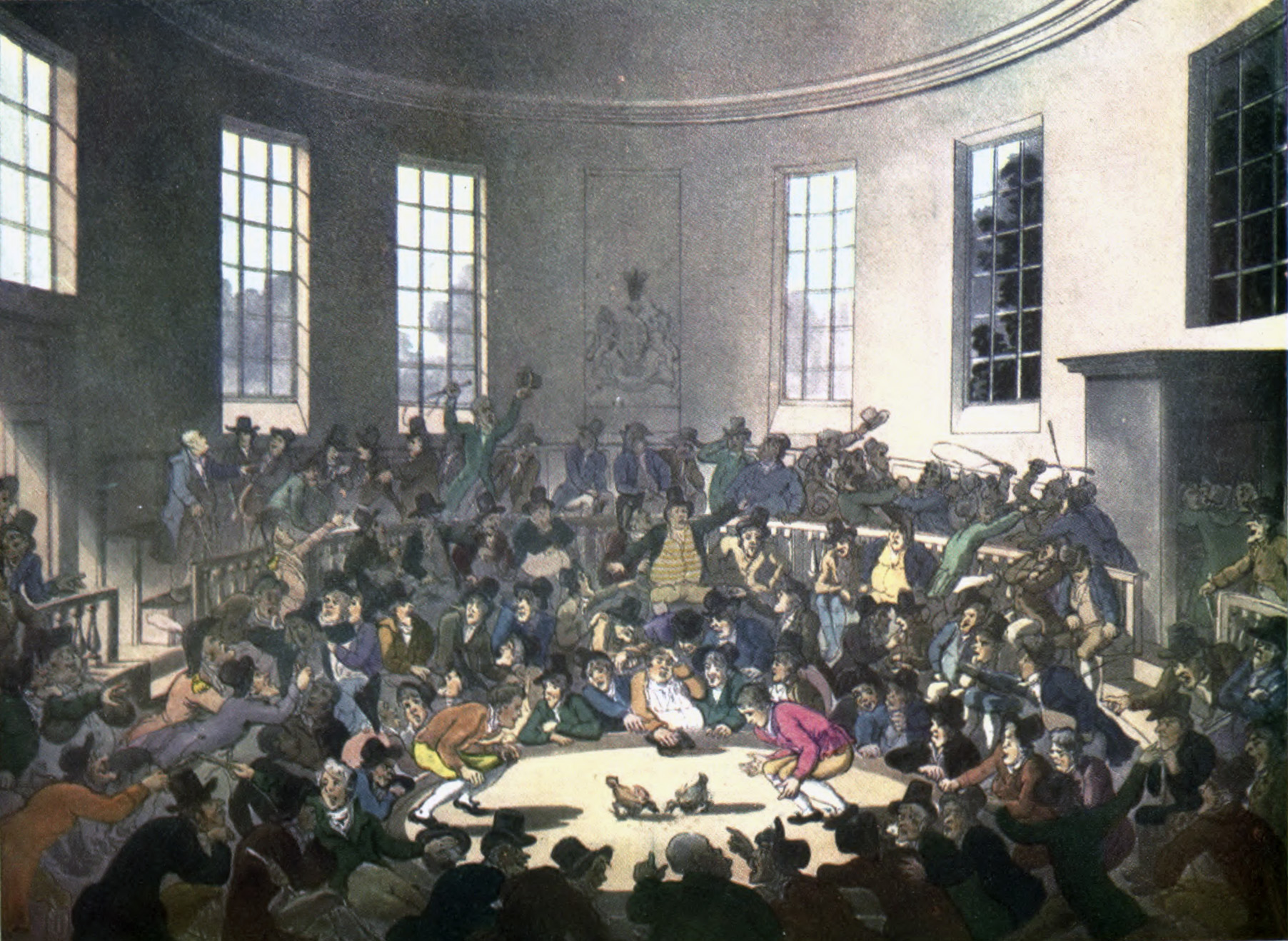
In 1903 Richard Blakeborough (1850-1918), celebrated collector of North Riding folklore, wrote an article for a cheery weekly family newspaper called the Northern Weekly Gazette about cockfighting in the village of Hutton Rudby.

Cockfight in London: c1808

He had written on the subject before and he knew that cockfights hadn't stopped as soon as they were banned in England in 1835 (they haven't stopped yet), but now he had been contacted by Richard Robinson, a 68 year old retired farmer living in Old Battersby, who had anecdotes to tell him.

You can see from his article that Blakeborough enjoys the old North Riding dialect most of all.  He was a dialect enthusiast, well known for his recitations and writings.  

He begins

As late as 1850, many a main was fought in or near to that village on a good Sunday morning.  And one Robert Dorking, a weaver about that date, possessed a bird of such note that on many occasions it was matched to fight some of the best birds in the North.  These contests came off somewhere in Newcastle, whither Dorking tramped from Rudby with his bird. 

(Robert Dorking's name was actually Robert Dalking, so I'll alter the name accordingly from now on)

The people of Hutton Rudby always knew, even before Dalking got out of the bed the next morning, when his bird had won.

"It was like in this way," 

said Richard Robinson, 

"when Dalking's cocks lost, for he sometimes used to hug as many as four on his back – his missus used to come out with her head lapp'd up in a shawl, looking that dowly and never a word for nobody.  She used to creep along with her head down, an' were as cross as a bear with a sore head.  But when Dalking came home victorious, she was out with her best hood, fleeing all over the village to spread the good news; there was no ho'ding her back at such times."

Sunday, 3 December 2023

Christmas recipes from Hutton Rudby, 1896

The Northern Weekly Gazette was a cheery weekly newspaper with editions published in Middlesbrough, Guisborough, South Bank, Stockton, Darlington and West Hartlepool.  Advertisements declared that

"The Northern Weekly Gazette is the most interesting and readable penny weekly paper in the North, and contains as much general reading as many shilling books"

It certainly was popular among Hutton Rudby families.  It only cost a penny and there was something in it for everybody – national and local news, local sports reports, household hints, recipes, jokes, serialised stories, pages for children, contributions welcomed and prizes to be won.

Mary Williams and her family were keen readers of the Gazette.  She was born in about 1856 in Hovingham and was married to a Welshman, Thomas Williams, who was coachman for the Blair family at Drumrauch Hall, their country house a little way outside Hutton Rudby.  Some time between the summer of 1895 (when their daughter Gladys was born) and the beginning of December 1896, the Williams family moved from Norton-on-Tees to one of the cottages by the entrance to the Hall on Belbrough Lane.  

Drumrauch Hall, O.S map revised 1911 
National Library of Scotland

These are two Christmas recipes sent in to the newspaper by Mrs Williams in 1896:

Northern Weekly Gazette, Saturday, December 5, 1896 
Christmas Mince Meat
Six nice apples, 2 lb currants, 1 lb Sultana raisins, 1 lb stoned raisins, 1½ lb moist sugar, ½ lb candied peel, 1 lb suet, 1 teaspoonful mixed spice, the rind of two lemons, the juice of one, 2 tablespoonfuls of orange marmalade, 1 teacupful of brandy; chop the apples and suet very fine, grate the lemons, mix all well together, press into a stone jar, cover air-tight; ready for use in a fortnight

A Good Family Christmas Pudding
1 lb breadcrumbs, ½ lb flour, 1 lb currants, 1lb Sultana raisins, 1 lb Muscatel raisins, 1 lb suet, 1 lb moist sugar, ½ lb mixed peel, 6 eggs well beaten, the rind and juice of a lemon, 2 oz powdered almonds, 1 teaspoonful of mixed spice, 1 teaspoonful salt, 1 teaspoonful ground ginger, 1 glass of brandy.  Mix all well together; boil for 8 hours.   
Mrs Williams, Drumrauck Cottage, Hutton Rudby, Yarm
Thomas and Mary spent the rest of their lives in Hutton Rudby.  They are buried in the churchyard there.


Saturday, 28 October 2023

Dark nights in Great Ayton: 1889

This sad little story is a reminder of village life before street lighting.  We are so conscious of light pollution nowadays, we can forget the hazards of the past.

That admirable woman Mrs Annabel Dott wrote on the subject after her experiences among the rural poor of Dorset during the First World War.  She had been shocked and dismayed by their conditions and wrote about it in 1919 with great feeling.  Being a practical person, she saw where matters could be improved and one issue was lighting: 

Lighting is another important rural matter.  The dark roads make traffic difficult if not impossible after sunset, and during long evenings when there is no moon it is not an easy matter for old people, women, or delicate folk to get about.  One of the attractions of the town is the brightly lit streets ...
Joseph Longstaff was a Great Ayton man born and bred.  His father John had been a weaver and the parish clerk, and Joseph became parish clerk in his turn.  He began his working life as a tailor but for many years ran the village Post Office, with a grocery shop alongside.

In 1889 he was 69 years old and working as a tailor again and as assistant overseer for the parish.  He lived with his wife Mary and 11 year old son Edward on the High Street.

Northern Echo, 25 October 1889

Missing from Great Ayton

Considerable anxiety is being felt at Great Ayton on account of the mysterious disappearance of the Clerk of the Parish (Mr Joseph Longstaff).  

It appears on Friday evening he left home in his slippers and never returned, and nothing has been heard of him since.  The night was excessively dark, the weather tempestuous, and an unusual amount of water was rushing down the River Leven, which flows through the village.  It is very much to be feared that he has missed the bridge and fallen into the water, in which case the body would probably be carried for miles, so strong was the current at the time.  

Mr Longstaff was an old inhabitant of Ayton, and much respected.  He was for many years postmaster.  The village is in total darkness during the evenings of the winter months.

This wasn't the only tragedy that autumn, and the question of lighting was clearly on people's minds.  This happened less than a week later:

Daily Gazette for Middlesbrough, 31 October 1889

Another Fatality at Great Ayton

Some time during last night Henry Peacock, late stationer and newsagent, was drowned in the River Leven at Great Ayton.  His body was found early this morning under the stone bridge.  His death furnishes another sad argument for the necessity of lighting up the village. 

For a while the problem was solved and the village was lit by gas but, in the summer of 1896, the Friends' School changed to electric lighting, the gas works were discontinued and the village was dark again.  

At the beginning of the new century, several town councils were experimenting with a new invention called the Kitson Lamp, which was invented by Arthur Kitson, an Englishman who had moved to the USA.

His lamp used petroleum and a carbon mantle similar to those used in gas lamps.  The petroleum was held in a metal reservoir some distance away and drawn up to the lamp under air pressure through a very fine copper tube.  When it reached the part of the tube that was inside the lamp, the heat of the mantle vaporised it and was lit by an ingenious device that did away with the need to climb up to the lamp on a ladder.  As only a very minute quantity of oil was subjected to heat at any one time, even if the tube was broken there was no chance of an explosion.  

It was described enthusiastically in the press as a brilliant and beautiful light, the nearest approach to pure daylight and more pleasant to the eye than electric light.  Not only that, but it cost under a penny an hour and no underground plant or digging up of the streets was needed.  The gentlemen of Great Ayton decided to install one:

Daily Gazette for Middlesbrough, 6 March 1901

The Lighting of Great Ayton

Mr Henry Richardson and Mr Thompson, trustees to the manorial rights of Great Ayton, have, with other local gentlemen, aided Mr John Dixon to place on the High Green at Great Ayton a Kitson patent 1,000 candle-power lamp.  The lamp lights the whole of the green, and has been so successful that it is hoped that before long the whole village will be illuminated.  

Since the gas works at Great Ayton were discontinued on the Governors of the Friends' School having electric light instituted the village has had no illumination at all.  It is hoped by the tradesmen and inhabitants generally that a number of the lamps will be procured not only to light the road as far as the stone bridge, but also for California.


Saturday, 22 July 2023

Defective bottles at Seaton Sluice: 1835

A chance find which has turned up among my family's papers – a furious letter about defective bottles.  No idea how it ended up in a solicitor's offices in Middlesbrough …

On Thursday 23 July 1835, a young man called John Latimer Nichol dashed off an angry letter to a Mr John Jobling of Seaton Sluice, the busy little port close to the village of Hartley in Northumberland.

John Latimer Nichol was a 28 year old merchant, born in Gateshead and working in the City of London.  Among their other business ventures, he and his father Anthony Nichol were in partnership with Ingleby Thomas Miller from Shincliffe, Co Durham as Nichol & Miller, bottle merchants in London.  New stock for their warehouses was shipped in bottle sloops to their premises at Dowgate Wharf on the Thames, near today's Cannon Street Station.  There was a booming market for bottles in the capital.

Nichol & Miller's bottles came from the North East, where the vast majority of glassmaking was carried out – there were bottleworks on the Rivers Tyne and Wear and the Northumbrian coast, supplying customers across the world.  

The region had all the advantages of cheap coal for the furnaces (glassmaking was a very convenient sideline for colliery owners) together with established shipping routes and easy availability of raw materials.  In 1790, the North East mostly made wine and claret bottles but when, during the 1820s, bottled beer began to be exported to hot climates, the manufacturers began to produce beer bottles.  


It's possible that Nichol & Miller dealt exclusively with the bottleworks at the bustling seaport of Seaton Sluice, acting as their London outlet.

John Jobling, who would soon receive this angry letter, came from a family that was of very considerable importance in Seaton Sluice.  He was the son of James Jobling who, in partnership with John Carr, had been running the Hartley coalmines since 1809.  They had prospered and, besides their collieries, brewery and malt kilns, Mr Jobling and Mr Carr had taken over the Hartley Bottleworks in 1820.  

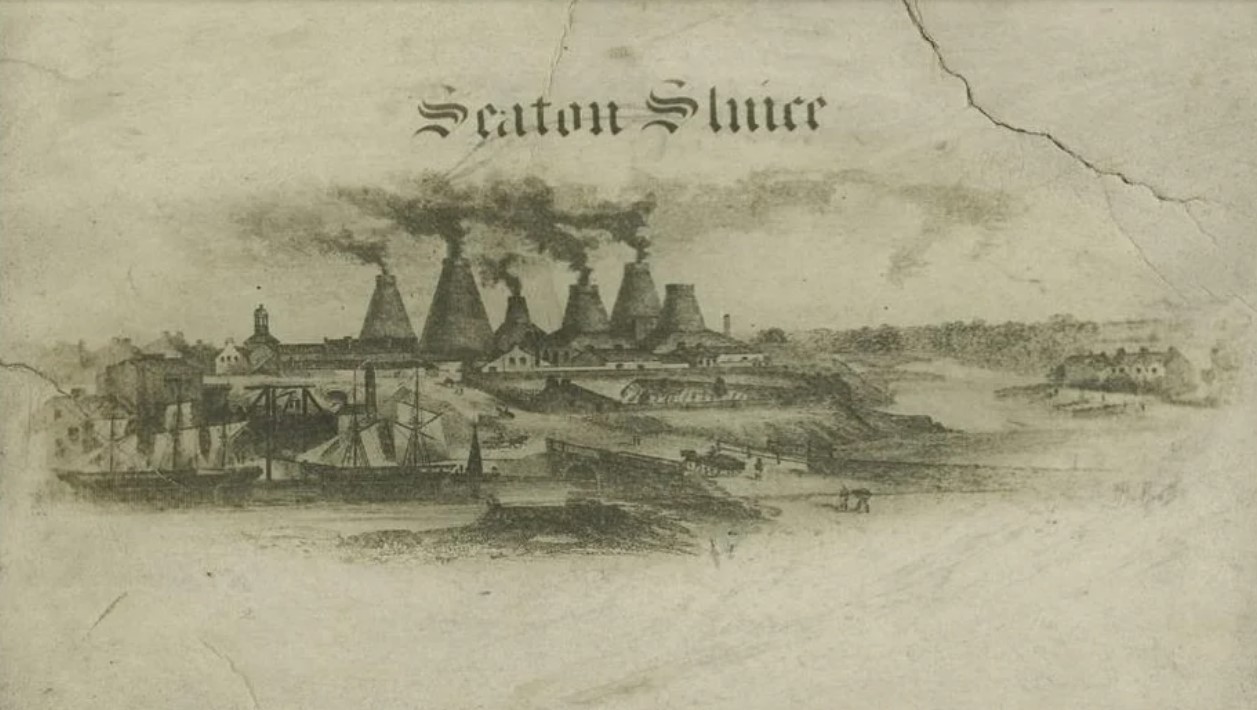
The works had been founded at Seaton Sluice by Thomas Delaval in 1763 and had swiftly grown into a huge concern – production had reached 1,740,000 bottles a year by 1777.  The following year, the first of three cone-shaped bottle houses was built to replace the old square buildings, their more powerful draught enabling more efficient furnaces.  There would be six of them eventually, dominating the skyline for the next 150 years and useful as sea marks to sailors. 

Seaton Sluice:  OS 1896 
CC-BY National Library of Scotland

In 1835 John Jobling was agent for the bottleworks of Messrs John Carr & Company.  Aged 42 and unmarried, he lived with his widowed mother and spinster sisters at the large, thatched Jacobean house called Seaton Lodge.  

This was originally the home of the Delaval family and was later occupied by the Delavals' land agent.  It was a picturesque old house, described in John Robinson's Illustrated Handbook to the Rivers Tyne, Blyth, & Wansbeck in 1894 in glowing terms – this was 22 years after the bottleworks and its smoky chimneys stopped work:
The situation of the house is all that can be desired, sheltered on all sides from the storms of the coast, the views from its windows up the charming dene, the sheet of water flowing in front of its terraced walks; while behind is one of those old fashioned gardens which delight the eye of all lovers of romantic landscape gardening.
Seaton Lodge from A History of Northumberland 1893

John Latimer Nichol wrote in such haste that his handwriting is a scrawl and he made a mistake with the date, giving it as 23 June 1835.  (It looks as though a later hand, possibly that of John Jobling himself, has corrected this to 23 July).  The letter was posted that very day and is marked

Z
JY 23
1835


He had just returned from a meeting with an important customer, who had sent for him to explain why they wouldn't be buying from Nichol & Miller in future.  John Latimer Nichol couldn't blame him.  He had been shown the product of one of his major rivals, and the difference in quality between Jobling's bottles and those bought from Cookson & Coulthard of South Shields was all too obvious.  Jobling's goods were not only inferior in colour and finish, but they were noticeably lighter and they gave way "at the shoulder".  John Latimer Nichol wrote bitterly, 
It is of little use our holding a stock of bottles which is only saleable till Mr Coombs or Mr Coulthard walk in & shew theirs
This was the third large business house whose custom they had lost and he wasn't going to order from Seaton Sluice again unless John Jobling could assure him that they would match the quality of bottles from Cooksons of South Shields and from Ridleys of Newcastle.
 
He asked John Jobling to meet his father Anthony Nichol in Newcastle to see 
if some thing cannot be done to meet our opponents in this matter for I have no fancy for carrying on my business at a rivals sufferances

This is John Latimer Nichol's letter – in some places I have had to make a guess at a word, and I've marked this with square brackets.  

Saturday, 20 May 2023

A Year's weather: 1895 by John Megginson

1895 – the year when Oscar Wilde was sent to gaol, when Middlesbrough Football Club won the FA Amateur Cup, Alfred Dreyfus was sent to Devil's Island, the future George VI was born and, in Bavaria, Adolf Hitler had his sixth birthday.

The year had begun, according to the pages of the Whitby Gazette, with the usual entertainments and concerts held by churches, chapels and societies.  In the months that followed, golf clubs opened at Whitby, Robin Hood's Bay and Goathland.  Ships were wrecked, lives were lost at sea and in the local mines.  Two men died in a thunderstorm at the Royal Show at Darlington, a father and son in a lightning strike at Kirkbymoorside.  The people of Helmsley were horrified to discover that the attentive young father, on holiday with his wife and baby, had murdered them both with a large carving knife and buried them a few miles outside town. 

And the year's weather on the North York Moors was recorded by John Megginson in verse.  He was a 52 year old farmer, woodman and local preacher who lived at Fryup Head with his wife Ann Frank and their large family.  Snowdrifts, floods and storms – here they are in lively verse: 

Original Poetry on the Year of Our Lord, 1895
John Megginson, Great Fryup, Lealholm, Grosmont


As long as we are all alive
We shall remember January of '95;
When it came in it was so coarse, 
It snew and blew with mighty force!
So those that had to go to preach
They had a task the place to reach;
And when they had to travel back
They were beat sometimes to find a track;
For down below, and on the moor,
The wind it made the snow to stoor;
And people round about the place
Could not get to the means of grace.

Saturday, 22 April 2023

Mourning in Eston: 1877

A small sheaf of receipted bills, which had survived by chance in the offices of Meek, Stubbs & Barnley, has given me the material for this sad story.

It was on the afternoon of Tuesday 23 January 1877 that a jury met at the Talbot Hotel in the High Street of South Eston.  They had been called by deputy coroner James Dent to inquire into a death.

Some 25 years earlier, ironstone had been discovered in the Eston Hills.  Before the ironmaster John Vaughan and his mining engineer John Marley found that first thick seam on 8 June 1850, Eston was just a little village.  With the opening of the Eston Ironstone Mine, men began to pour in from across the country, and soon terraces of housing were thrown up and the little enclaves of South Eston, California and Eston Junction came into being.

The inquest on that January afternoon in 1877 had been called because of the death of James Scaife.  He had come to Eston from Nidderdale.  Born to linen weaver Thomas Scaife and Esther Metcalfe on 11 November 1831, he was baptised at the Pateley Bridge Wesleyan chapel.  By the time he came to Eston in the early 1860s, he had been at work for more than 20 years.  

When he was 9 years old, living with his family at the Little Kiln Hill Milestone near Glasshouses, he and his 12 year old sister Ann were working in one of the Nidderdale textile mills.  When he was 19, the family was living at Crags, near the Blazefield quarries, and he was working with his father as a gardener.  Mining was a local industry, but he hadn't chosen to work with his brother-in-law Henry Calvert, Ann's husband, who was a miner in one of the Nidderdale coal mines.  

In the 1861 census, James was 30 years old, living on his own in Pateley Bridge and driving a carrier's cart.  By the late summer of 1863 he was in Eston and had married a young widow with 3 small boys.

Elizabeth Fielding was born in 1828 to John and Jane Fielding in Skirbeck, a village on the east coast of Lincolnshire near Boston.  In the summer of 1848 she married Richard Earley, who was a few years her elder, born in 1820 to Charles and Mary Earley at Kirton in Holland, a few miles to the south of Boston.  

In the late 1850s, Richard moved to Eston to work in the ironstone mines, bringing Elizabeth and their little boy Richard.  It seems that Elizabeth had already known a good deal of grief in childbearing – after more than 10 years of marriage, Richard was her only surviving child.   

South Eston c1913:  CC-BY National Library of Scotland

There will have been familiar accents around them in their new home because a good many Lincolnshire men came to work in the Eston mines.  William Pett, a 41 year old platelayer from the same village as Richard Earley, was lodging with them in 1861.  He was probably an old friend or relation of Richard's, and they had called their new baby after him – little William Pett Earley was only a month old at the time of the census.  By then, the family was living at 71 William Street, South Eston.  It was one of the streets that led off the High Street towards the moors.

Saturday, 25 March 2023

Lord Falkland fights a duel: 1809

This is the story behind this tablet in the chancel of Hutton Rudby church:

Tablet to Charles John Cary, 9th Viscount Falkland, his wife & daughter
Hutton Rudby Church

Captain Charles Cary RN, 9th Viscount Falkland, died of his wounds in the early hours of Thursday 2 March 1809.  It was about 36 hours since he had been shot in the lower part of his abdomen and the surgeon hadn't been able to find the bullet and extract it.  The autopsy would reveal the full extent of the damage – the pistol ball had wounded Lord Falkland's large intestine and lodged in his spine.  

He died as the result of a duel and he died in his opponent's house.  He was forty years old and he left a young widow with four small children.

The year 1809 had begun unpromisingly for him with a fire.

In January 1809, he and his wife and their little children were in London for the season and had taken the first floor at the fashionable Warne's Hotel in Conduit Street.  The hotel was made up of two houses – numbers 19 and 20 Conduit Street stand there now – and it stretched back towards the church of St George's, Hanover Square.  

St George's Hanover Square, by T Malton 1787

On 30 January 1809, Warne's Hotel went up in flames.  Some newspaper reports said that the fire started in Lord Falkland's dressing room because a poker had fallen from the grate.  Some said it was Lady Falkland's dressing room.  One report said that Lord Falkland rushed to the room hoping to save some cash in his writing desk, but was beaten back by the flames and that he had lost £300.  Another report said it was £200.  There were rumours that Lady Falkland lost all her jewels in the blaze.

When the alarm was raised, she was able to escape from her drawing room with the three children and the baby and take refuge in a friend's house in Oxford Street.  Meanwhile, men were dashing into the hotel to save as much of the furniture and contents as they could and servants were running up and down the stairs with as much water as they could carry.  Soon the horrified congregation in nearby St George's could see flames through the church windows.  There was a mass exodus for the door while someone, with great presence of mind, scooped up the church silver and took it to a place of safety.  The charity school children had been at the service as usual – they rushed out into the street, boys without their hats and girls without their cloaks and bonnets.  The road filled with people running in all directions.

Traffic came to a standstill as carriages four abreast blocked Bond Street.  The fire engines couldn't get through and the Earl of Chesterfield, who was Colonel of the Old St George's Volunteers, sent a party of troopers to clear the way.  Earl Percy sent his private fire engine from Northumberland House and the Duke of Portland – who was then Prime Minister and would before long die in office – helpfully sent a supply of ale to the firemen.  But first they needed water.  

When the engines reached the scene, water couldn't be had – one report said it was an hour before the firemen could get a supply.  The flames burst through the windows of the hotel with astonishing speed and the roof was soon destroyed.  

Sightseers gathered and had to be kept back by Horse Guards and Foot Guards while the wind, blowing a strong gale, blew red-hot cinders away, over and into Swallow Street and Vigo Lane in a shower of fire.  People climbed up to their rooftops to beat out the sparks.

A fire in London, 1808

In the days that followed the fire, while the hotel was rapidly being rebuilt, Lord Falkland and his family settled into Dorant's Hotel in Albemarle Street.  And now things began to look up for Lord Falkland.  While he was out and about enjoying Society life, his career prospects started to improve.